Hyrox Training Plan: 6-Week Quick Start
A focused 6-week HYROX® plan for athletes with a fitness base who need structured race prep. 4 sessions per week covering running, stations, and strength work.
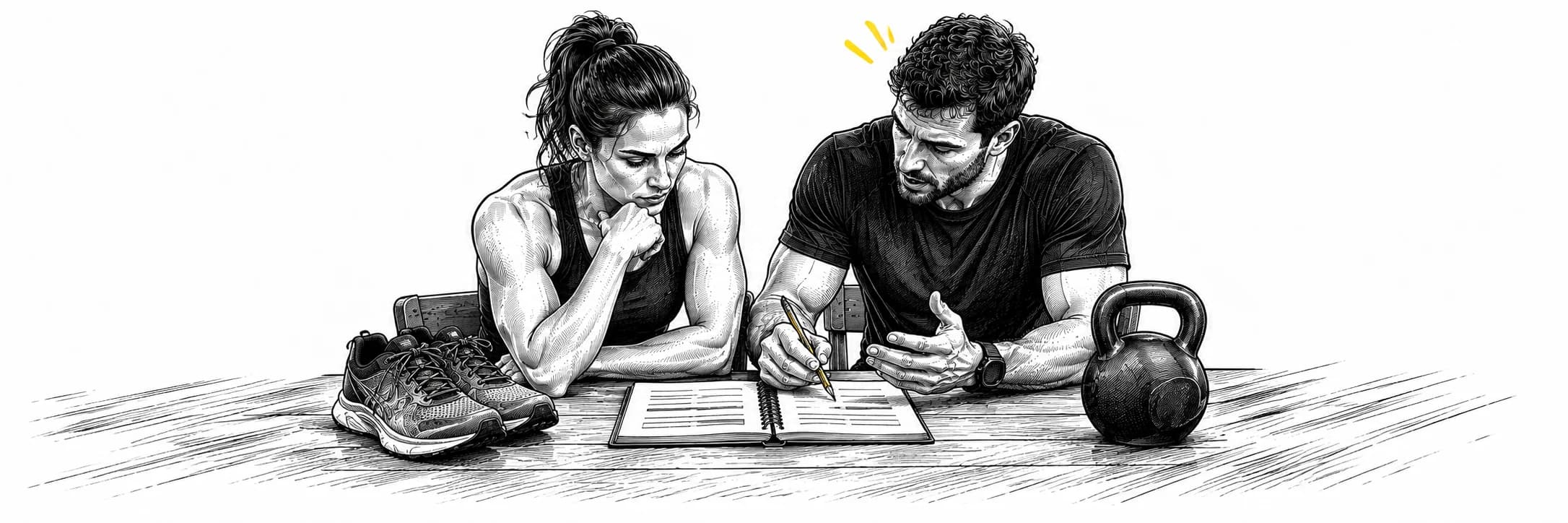
What a HYROX® week must cover
Current Singles alternates eight 1 km runs with SkiErg, sled push, sled pull, burpee broad jumps, rowing, farmers carry, sandbag lunges and wall balls. A useful week therefore develops running, strength and station skill, but the rulebook does not prescribe a training hierarchy, frequency or schedule. Emphasis should follow the athlete's weakest race-relevant qualities, experience and injury history.
HYROX® Singles Rulebook 2026/27
What six weeks can and cannot do
Six weeks can organise a short preparation block, but it is not a validated minimum, guarantee or substitute for a longer build when the athlete lacks a running, strength or movement base. Start from current capacity and the time available. Three, four or five training days are options, not thresholds. Count total running, station, resistance and life load; add volume or intensity gradually and change one main variable at a time.
Rosenblat et al. training-intensity-distribution network meta-analysis · ACSM 2026 resistance-training position stand
Three-day example
Example: day 1 easy running plus brief technique; day 2 full-body strength; day 3 a quality run or controlled race-specific combination. Separate the days as recovery and availability require. One session can combine objectives, but fixed 75–90-minute sessions, prescribed heart-rate zones and a weekly long run are not compulsory.
Rosenblat et al. training-intensity-distribution network meta-analysis · Schumann et al. concurrent-training systematic review and meta-analysis
Four-day example
Example: day 1 easy run; day 2 strength and selected stations; day 3 quality run; day 4 controlled mixed practice. Keep most endurance work manageable and reserve harder work for sessions that can be completed with sound technique. No evidence makes one named intensity distribution or exact weekday pattern best for every recreational HYROX® athlete.
Rosenblat et al. training-intensity-distribution network meta-analysis
Five-day example
Example: two easier aerobic exposures, one quality run, one strength-focused session and one mixed or station-focused session. These categories can overlap. Five days should not mean five hard days. Reduce volume when adding race-specific combinations, and avoid duplicating demanding lower-body work simply to fill a template.
Schumann et al. concurrent-training systematic review and meta-analysis · Ramos-Campo et al. concurrent strength and HIIT meta-analysis
Sequence hard sessions deliberately
Place technically demanding, fast or heavy work where it can be performed safely. Concurrent endurance and strength training can improve both qualities; evidence does not support a blanket claim that running must always precede stations or that a particular same-day order is universally superior. If two demanding sessions repeatedly impair performance or recovery, separate them, reduce one dose or alternate emphasis.
Schumann et al. concurrent-training systematic review and meta-analysis · Ramos-Campo et al. concurrent strength and HIIT meta-analysis
Progress and recover
Track completed work, session RPE, performance, sleep, soreness and symptoms. Progress may mean more distance, load, repetitions or quality, but it need not rise every week. Use easier days or weeks when fatigue accumulates or before competition. Stop and seek appropriate assessment for chest pain, fainting, acute injury or persistent worsening pain.
ACSM 2026 resistance-training position stand
FAQ
Is three days per week the minimum?
No universal HYROX® minimum has been established. Three days can be a practical template, while the useful dose depends on training history, session content and recovery.
ACSM 2026 resistance-training position stand
Must the long run be on Saturday?
No. Place longer or harder running where it fits recovery and life demands. The weekday itself has no special training effect.
Rosenblat et al. training-intensity-distribution network meta-analysis · ACSM 2026 resistance-training position stand
Should running always come before stations?
No. Put the priority or technically sensitive task first when appropriate, and sometimes practise race order. Neither order must govern every session.
Schumann et al. concurrent-training systematic review and meta-analysis · Ramos-Campo et al. concurrent strength and HIIT meta-analysis
How many hard sessions should I schedule?
There is no fixed number. Start with what you can recover from while maintaining performance and technique, then adjust from your response.
Rosenblat et al. training-intensity-distribution network meta-analysis · ACSM 2026 resistance-training position stand
Do I need fixed heart-rate zones?
No. Individually assessed zones can help, but pace, perceived effort, breathing and session performance are useful alongside heart rate.
Rosenblat et al. training-intensity-distribution network meta-analysis · ACSM 2026 resistance-training position stand
The target finishing window is sub-80 to sub-90 minutes for the solo open category. Across recent seasons of Repz race data, athletes hitting this bracket typically arrive at the race with a 5 km time under 22 minutes and can perform 15 unbroken wall balls at 6 kg without stopping for breath. If that describes you, this plan fits.
| Situation | Written plan | Repz |
|---|---|---|
| Logged strength work | Adjust the example using your records. | Strength inputs and session feedback guide progression. |
| Missed session | Review what to retain or move. | Missed work can affect the relevant progression. It is not automatically redistributed. |
| Different equipment | Check the demands of each alternative. | Check required equipment and the limits of any alternative. |
| New race date | Revisit the preparation calendar. | The entered race date helps determine training phases. |
Repz structures running, strength and station training around your race date, current performance and available training days. Logged training and feedback help shape subsequent sessions. Explore Repz.
Race simulation note (Day 3): Clock your transitions, not just your station and running splits. Repz data shows that recreational athletes lose 3–6 minutes per race in transitions that go unmanaged (stopping fully between segments, resetting breathing passively instead of actively managing it, and starting the next running kilometre too slowly after a hard station). Practice moving through transitions without standing still.
Repz structures running, strength and station training around your race date, current performance and available training days. Logged training and feedback help shape subsequent sessions.
Put this into practice
Was this helpful?
Related Articles
12-Week HYROX Training Plan: Weekly Schedule
Follow an adaptable 12-week HYROX plan with four scheduled days per week, running, station practice and a race-week taper. Download the matching printable PDF.
how to train for hyroxHow to Train for Hyrox: Complete Guide
A current, evidence-bounded framework for HYROX training: race demands, running, strength, station skills, combined sessions and tapering.
hyrox home workoutHyrox Training at Home: Minimal Equipment
Plan HYROX training at home with running, strength and station practice. Understand equipment limits and where race-specific practice matters.
Know Where You Stand
Reading is good. Training with a plan built around your weaknesses is better. Get Repz and turn what you just read into your next session.