Hyrox Rowing Guide: 1,000m Pacing, Technique & Training
HYROX rowing: 2026/27 distance and station rules, Concept2 technique, damper and pace calculations, plus adaptable practice ideas.
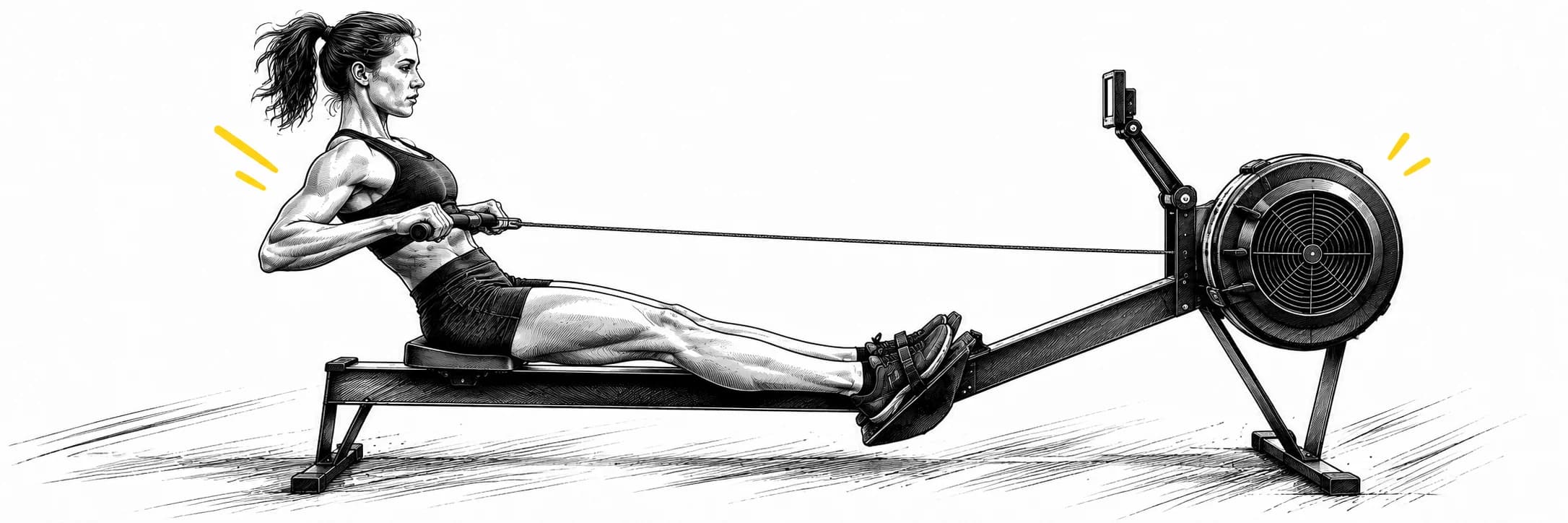
This guide covers standard Singles and Doubles for season 2026/27. Training examples are optional coaching ideas to adapt to your preparation, not competition requirements or promised time gains.
This guide covers the exact distance, the machine you'll use, the technique that matters under fatigue, a pacing strategy built on real split data, and the workouts that prepare you for race day. Every recommendation is grounded in division benchmarks and the training principles behind the Repz app.
Distance, machine and competition rules
The rowing station follows running segment 5. Burpee Broad Jumps are station 4, with a run between them and rowing; the sixth run then precedes Farmers Carry. Rowing covers 1,000 m in the standard Singles and Doubles divisions discussed here. Use the assigned ergometer. The judging team resets the monitor. In Singles, remain seated until the distance is complete and a judge confirms completion. These statements do not replace the separate Adaptive rules. HYROX® Singles 26/27 · §1 / §8.5 HYROX® Doubles 26/27 · §8.5
Doubles cover 1,000 m as a team; the rulebook does not require 500 m each. Section 7.2 explicitly illustrates alternating after self-selected distances, such as 250 m. However, section 8.5 also says an athlete may not leave the seat until 1,000 m and judge confirmation. Those passages conflict. Confirm the changeover procedure with the event’s Head Judge rather than treating either passage as an unqualified instruction. Section 8.5 separately prohibits adjusting a partner’s damper or footstraps and passing the handle to them. HYROX® Doubles 26/27 · §7.2, p.24 / §8.5, p.32
HYROX® uses the Concept2 RowErg. The current model has an air-resistance flywheel, a nickel-plated chain and a PM5 monitor. Concept2 consolidated the former Model D and Model E names under RowErg. Familiarisation is a useful practice option; this guide does not prescribe a mandatory number of sessions before racing. Concept2 RowErg Concept2 RowErg naming Concept2 / HYROX®
Rowing technique
Use the manufacturer’s movement sequence as a reference during practice. You could ask a coach to observe a short, controlled piece or review a side-on video. Treat this as a technique exercise, not a test that predicts a particular improvement in seconds.
Catch, drive, finish and recovery
At the catch, keep the arms straight, shoulders relaxed and shins near vertical without moving beyond perpendicular. Start the drive with the legs, then swing the body through vertical and add the arm pull. Finish with a slight backward lean and the handle below the ribs. On recovery, extend the arms, hinge forward and bend the knees after the hands have passed them. Concept2 Rowing Technique
Damper and drag factor
For Singles and Doubles, the race preset is damper 6; adjustment is permitted. Footplates start at position 4 and can be adjusted before rowing. In Doubles, only the working athlete may change the damper. The lever controls airflow, while the PM measures drag from flywheel deceleration. Temperature, elevation and accumulated lint can change the drag associated with a lever number. There is no fixed conversion from damper 4–6 to drag 110–130. HYROX® Singles 26/27 · §8.5 HYROX® Doubles 26/27 · §8.5 Concept2 Damper
To view drag factor in training, select More Options, then Display Drag Factor on the PM5 and begin rowing. Compare the displayed value rather than assuming two machines have identical drag at the same lever setting. Concept2 PM5 · Viewing Drag Factor
Pacing the 1,000 m
Choose a practice target from your own recent sessions and compare how different starts feel. Even pacing and a controlled faster finish are options to test; neither is established here as universally fastest for HYROX®. The table is arithmetic, not a ranking or a set of male, female, Pro or beginner standards.
Pace calculations
On the RowErg, /500 m is the pace expressed as time per 500 metres. For a completed 1,000 m, average pace multiplied by two gives rowing time. For example, 2:00/500 m corresponds to 4:00. This calculation excludes entry, setup and exit time. Concept2 PM5 · Units
| Average /500 m | 1,000 m time |
|---|---|
| 1:40 | 3:20 |
| 1:50 | 3:40 |
| 2:00 | 4:00 |
| 2:10 | 4:20 |
| 2:20 | 4:40 |
Stroke rate
Stroke rate means strokes per minute, not speed. At an average 28 strokes per minute for a four-minute row, the calculation is 28 × 4 = 112 strokes. It is not 56–58. A higher rate alone does not establish a faster pace; use the PM’s pace and rate readings together. Concept2 PM5 · Understanding Stroke Rate
Rowing practice ideas
Optional practice example: after a suitable warm-up, try a few controlled 500 m repeats with recovery you can comfortably manage. Record pace, stroke rate and how the piece felt. A separate technique session could compare two comfortable rates at a similar pace. Adjust volume, recovery and intensity with your coach; this is not an evidence-based requirement to row two or three times every week.
After Burpee Broad Jumps
For sequence practice, remember the order: Burpee Broad Jumps, running segment 5, rowing. You can practise a shortened version, clearly labelled as a drill rather than a full race simulation. Compare observations across sessions; a time difference alone cannot identify how much technique you lost. There is no verified promise here that two setup strokes lower heart rate or that heavy legs necessarily resolve after 200 m. HYROX® Singles 26/27 · §1
Checks before race day
Before racing, practise the manufacturer’s stroke sequence, identify a comfortable setting and learn to read the PM. At the station, follow the judging team’s setup and completion instructions. Do not infer a technique fault solely from sore arms or assume a set stroke rate guarantees faster rowing. Concept2 Rowing Technique HYROX® Singles 26/27 · §8.5
FAQ
Was this helpful?
More Training Guides

Hyrox Burpee Broad Jumps: Technique, Pacing, Training & Tips
Master the burpee broad jump in HYROX: perfect your technique, avoid common faults under fatigue, pace every rep, and build fitness with an 8-week training plan.

HYROX Doubles guide: rules, weights and teamwork
Prepare for HYROX Doubles with the 2026/27 rules, all division weights, station changeovers, partner training examples and a race-day checklist.

Hyrox Farmers Carry: Weight, Technique, Workouts & Benefits
Master the Hyrox farmers carry with division weights, grip technique, muscles worked, and periodized workouts to boost your race-day performance and overall finish time.
Know Where You Stand
Reading is good. Training with a plan built around your weaknesses is better. Get Repz and turn what you just read into your next session.