Sled Push Substitutes
No gym access? These sled push substitutes train the same muscles for HYROX® station 2 — with clear notes on what each option can and cannot replicate.
No Sled, Still Prepared: The Reality of Sled Push Substitutes
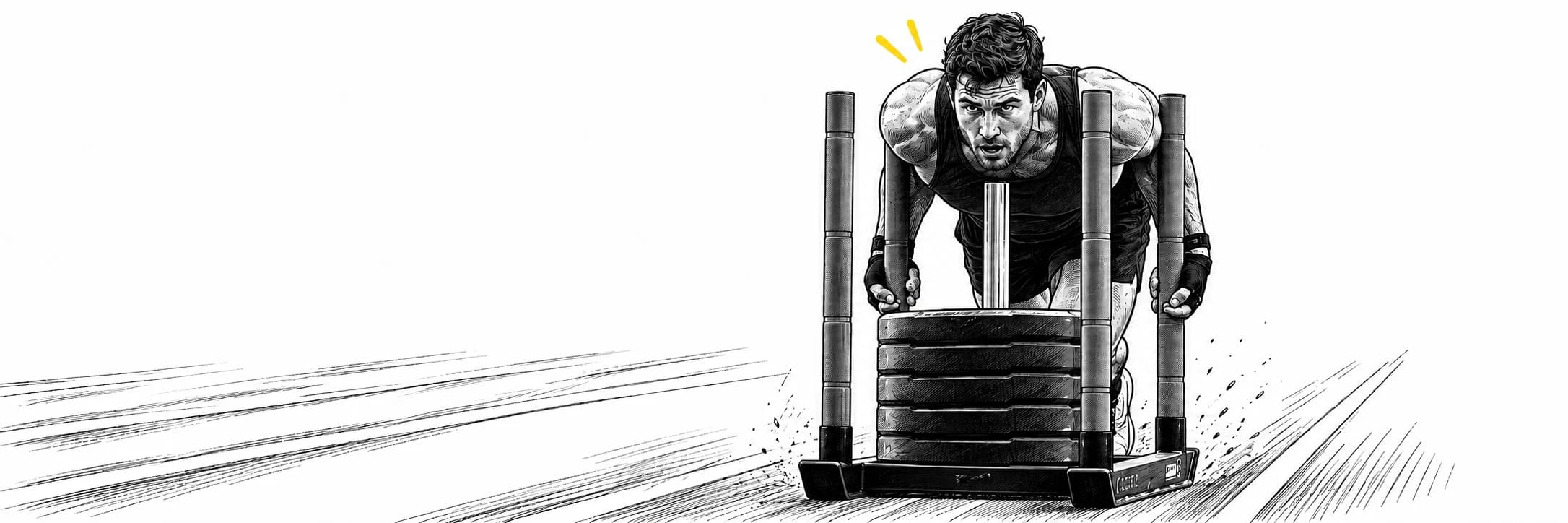
Station 2 in HYROX® is 50 metres of loaded sled. Open men push 102 kg. Open women push 72 kg. The mechanics demand a sustained low body angle, explosive quad drive, and the ability to hold horizontal force application for 60–150 seconds depending on your ability level. Most athletes do not have a pushing sled at home, and a significant portion train in commercial gyms where sleds do not exist.
The honest answer to "what can I use instead?" is that no substitute fully replicates the sled push. The combination of load, surface friction, forward lean mechanics, and zero eccentric phase is specific to a pushing sled. What substitutes can do is train the underlying physical qualities — quad and glute drive, horizontal force production, sustained anaerobic output, positional endurance — so that when you do get on a sled, you are not starting from zero.
This article covers six specific substitutes with clear analysis of what each trains, what it misses, and how to use it effectively in a HYROX® preparation block.
What the Sled Push Actually Demands
Before choosing a substitute, it helps to break down exactly what you are trying to replicate. The sled push at race weight trains:
- Quad-dominant concentric drive: no eccentric phase, pure pushing output
- Hip extension under load: glute max and hamstrings extending at speed across 50 metres
- Positional endurance: maintaining a 45-degree forward lean for the full duration
- Anaerobic-to-aerobic transition: a sustained high-intensity effort that draws on both phosphocreatine and glycolytic systems
- Grip and upper body structural integrity: the arms, lats, and shoulders form the force transmission bridge between your legs and the sled
Substitutes that only address one or two of these qualities are less effective than those that address three or more. The ratings below reflect how comprehensively each option covers the full profile. For a deeper breakdown of the mechanics driving your sled push time, the HYROX® sled push guide covers positioning and force application in detail.
Substitute 1: Barbell or Plate Push on a Smooth Floor
Effectiveness: 8/10 — closest available substitute
If you have a smooth rubberized gym floor, a large bumper plate, or a stack of weight plates on a low-friction surface, the floor plate push is the most mechanically similar substitute to an actual sled. Stack 20–40 kg of weight plates on a single large plate base, place your hands on the top of the stack, and push across 15–25 metres using the same forward lean and short-stride pattern as the sled.
What it trains: Forward lean mechanics, quad and glute concentric drive, horizontal force application, upper body structural load, sustained anaerobic output. The friction profile is different from a sled — typically lower resistance but less consistent — yet the positional demands are nearly identical.
What it misses: Load precision. You cannot easily replicate 102 kg or 72 kg on a plate stack with confidence. Surface friction varies by floor type, making consistent effort calibration difficult. Athletes accustomed to the handle height and grip angle of a sled will notice a positional difference.
How to use it: Sets of 20–25 metres at a load that challenges you to maintain forward lean. Four to six sets with two minutes of rest. If the floor allows it, this should be the primary substitute in a gym without a dedicated sled.
Substitute 2: Prowler or Weighted Sled Variant
Effectiveness: 9/10 — near-perfect when available
A prowler or low-profile pushing sled is the functional equivalent of the HYROX® sled in most respects. The pushing mechanics, handle height, load, and forward lean demand are all directly transferable. If your gym has one, it should be your first choice — not a substitute in the purest sense, but often overlooked by athletes who do not check for alternative sled equipment at their facility.[1]
What it trains: Everything the HYROX® sled trains. Quad drive, glute extension, horizontal force production, positional endurance, grip and upper body integration. At race weight equivalents, the anaerobic demand closely mirrors the race station.
What it misses: Surface differences exist between gym floors and HYROX® competition surfaces. Competition sleds tend to run on specific rubberised tracks with calibrated friction. If you train on carpet or smooth tile, your force output and perceived effort will differ from race day. This is a minor calibration issue, not a fundamental gap.
How to use it: Load to race weight and run sets of 25 m and 50 m. Progress to 110–120% race weight for overload sets once baseline mechanics are solid. The sled push workouts article has structured interval progressions that apply directly to prowler work.
Substitute 3: Partner Push (Human Resistance)
Effectiveness: 7/10 — highly specific, underused
Two athletes, one pushing. The resisting partner crouches low and braces their feet against the ground while the pushing athlete drives them forward over 15–25 metres. This is one of the most underrated substitutes available because it requires no equipment and delivers some of the best mechanical replication of the sled push pattern.[2]
What it trains: Forward lean mechanics, horizontal force application, quad and glute drive, sustained push output. The resistance partner provides variable but genuine friction, and the pushing athlete must maintain the same 45-degree angle and short-stride drive pattern as the sled. Upper body structural load is present because the pushing athlete must hold contact with the partner's shoulders or back throughout.
What it misses: Load standardisation. A 70 kg partner resisting on smooth tile is not equivalent to 102 kg on a calibrated sled track. Resistance changes as the partner fatigues or shifts position. You cannot easily overload beyond the partner's body weight without modifications. It also requires two people available at the same time.
How to use it: Sets of 15–20 metres, alternating roles. The pushing athlete works; the resisting athlete recovers. Three to four rounds each. This is particularly effective as a quality substitute for athletes training at home with a training partner. It also has zero equipment cost, which makes it one of the best HYROX® home training options for replicating Station 2.
Substitute 4: Heavy Incline Treadmill Walk with Weighted Vest or Pack
Effectiveness: 5/10 — limited mechanical transfer, high aerobic value
Walking at maximum incline (12–15%) on a treadmill while wearing a 20–30 kg weighted vest or backpack. This is a commonly recommended substitute, and it has genuine value — but it is important to understand exactly what it does and does not replicate.
What it trains: Quad and glute activation under load at a sustained output. The steep incline demands hip extension and knee drive that shares characteristics with the sled push. Heart rate response and aerobic demand are meaningfully similar to a moderate-paced sled push effort. Grip and upper body are minimally engaged, which removes one limiting factor and allows longer training durations.
What it misses: The forward lean mechanics that define the sled push. On a treadmill, your body is upright relative to the incline — the treadmill surface moves beneath you rather than requiring you to push through horizontal force into a stationary load. The neuromuscular pattern is fundamentally different. You are not rehearsing the skill of applying horizontal force against resistance; you are walking on an angled surface. For athletes who genuinely have no other option, this builds the engine; it does not train the skill.[3]
How to use it: 10–20 minute sessions at maximum incline with a load equivalent to 25–35% of body weight. More effective as aerobic conditioning work than as a mechanical rehearsal for Station 2. If this is your only option, supplement it with the technique drills described in the sled push technique guide.
Substitute 5: Bulgarian Split Squat and Heavy Loaded Step-Up
Effectiveness: 6/10 — strong strength builder, low mechanical transfer
Bulgarian split squats performed with a barbell or heavy dumbbells, combined with step-ups onto a 30–40 cm box under load. Both movements develop quad and glute strength through the ranges most relevant to sled push mechanics.
What it trains: Quad and glute hypertrophy and strength through the concentric range that powers the sled push stride. Single-leg training also addresses the unilateral demand of the sled push — each stride is a single-leg push, not a bilateral squat. Heavy split squats at 80–100% of body weight per leg develop the same contractile force capacity the sled push requires.[4]
What it misses: The forward lean position, horizontal force application, and the sustained anaerobic output of the sled push. Bulgarian split squats have a significant eccentric component — the lowering phase — which the sled push completely lacks. This means recovery demand is higher per set, and the neuromuscular pattern is trained partially in reverse. These are excellent accessory exercises for building the physical foundation of the sled push. They are not the push.
How to use it: Three to four sets of 6–10 reps per leg at heavy load. Treat these as strength builders rather than as direct movement rehearsal. Pair them with one of the higher-rated substitutes above rather than using them as your sole Station 2 preparation. The HYROX® gym-only plan integrates split squat programming into a full weekly structure.
Substitute 6: Resisted Band Walk in Sled Push Position
Effectiveness: 6/10 — best technique rehearsal available without equipment
Anchor a heavy resistance band (40–60 kg equivalent) at waist height to a fixed point behind you. Assume the sled push body position — 45-degree lean, hands gripping the band at hip height, arms nearly locked — and walk forward against the band tension for 10–20 metres.
What it trains: Forward lean positional endurance, the structural arm and shoulder load of holding the push position, and the hip extension pattern of driving forward against horizontal resistance. The band provides a force profile that feels surprisingly similar to sled push resistance — most pronounced at the start, easing slightly as you move away from the anchor. This is one of the best available tools for drilling the exact body geometry of the sled push with no equipment beyond a resistance band.[5]
What it misses: Absolute load. Resistance bands cap out well below 102 kg equivalent, so the contractile demand on the quads and glutes is lower than race conditions. The force profile also diminishes as you move further from the anchor, which is the opposite of constant friction resistance. This is a technique tool, not a strength-builder.
How to use it: Four to six sets of 15–20 metres, focusing on holding the 45-degree lean throughout. Use this in the warmup before any sled-adjacent training, or as your primary technique drill in a home training context. This is detailed further in the sled push technique guide alongside the wall lean drill and isometric lean hold variations.
How to Choose the Right Substitute
The right choice depends on what your training environment actually offers. A decision framework:
If you have a prowler or alternative sled at your gym: Use it. Load to race weight and train with the interval structures in the sled push workouts article.
If you have a smooth floor and weight plates: The plate push is your primary substitute. Supplement with split squats and step-ups for strength building.
If you have a training partner: Partner push twice per week, combined with resisted band walks for technique work.
If you are training entirely at home: Resisted band walks for technique, heavy pack incline walks for aerobic conditioning, and Bulgarian split squats for strength. Stack all three across the week.
If you have access to a gym but no sled: Plate push as your primary, split squats as your secondary, incline treadmill for aerobic conditioning.
No single substitute covers every dimension of the sled push. The most effective approach in the absence of actual sled equipment is to stack two or three complementary substitutes — one targeting mechanics, one targeting strength, one targeting sustained output. The HYROX® training plan shows how to periodise this across a full preparation block.
Substitute Comparison Table
| Substitute | Mechanics | Quad/Glute Load | Sustained Output | Ease of Access |
|---|---|---|---|---|
| Plate push (smooth floor) | High | High | High | Medium |
| Prowler / alt sled | Very High | Very High | Very High | Low–Medium |
| Partner push | High | High | Medium | High |
| Incline treadmill + pack | Low | Medium | High | High |
| Bulgarian split squat / step-up | Low | High | Low | High |
| Resisted band walk | Very High | Low | Medium | High |
Programming Substitutes in a HYROX® Build
Substitutes are most effective when used with the same logic you would apply to actual sled training. The key variables are load (relative to what you are capable of in the substitute), duration (targeting the 60–150 second effort window of the race station), and frequency (one to two sessions per week).
A practical 4-week substitute block for athletes without sled access:
Week 1–2: Build mechanics and aerobic base
- Resisted band walks: 6 x 20m, focusing on lean angle and arm position
- Incline treadmill: 3 x 10 minutes at max incline with 20–25% bodyweight load
- Bulgarian split squats: 4 x 8 reps per leg at 70–80% of your 1RM estimate
Week 3–4: Add load and sustained output
- Plate push (or prowler if available): 5 x 25m, 2 minutes rest
- Partner push: 4 x 20m each athlete, alternating
- Bulgarian split squats: 4 x 6 reps per leg at 85–90% load
In the final 4 weeks before your race, prioritise getting onto an actual sled — at a HYROX®-affiliated gym or a specialist training facility — at least twice. No substitute programme fully replaces mechanical rehearsal at race weight. The goal of substitute training is to arrive at that sled as physically prepared as possible, so the actual movement click into place quickly.
See the HYROX® workout guide for how Station 2 preparation integrates with all eight stations across a full training cycle.
Frequently Asked Questions
Can I prepare adequately for the HYROX® sled push without ever using a sled? You can build a strong physical foundation — quad and glute strength, horizontal force mechanics, and sustained anaerobic output — through the substitutes above. What you cannot fully replicate is the specific combination of load, surface friction, and positional demand of the actual sled. The final 4–6 weeks of race preparation should include at least some actual sled time to translate the physical foundation into race-ready mechanics. Even two or three sled sessions in the final month is substantially better than zero.
What is the closest substitute to the HYROX® sled push for home training? The partner push covers the most mechanical ground if you have a training partner available. If training solo, the resisted band walk in sled push position best replicates the body geometry and horizontal resistance pattern, though at lower absolute load. Combine it with heavy Bulgarian split squats for strength development and an incline treadmill session or loaded hill walk for sustained aerobic output.
How heavy should I load substitutes relative to the actual sled weight? This depends on the substitute. For plate pushes and prowler work, target race weight equivalents as your baseline — 102 kg for Open men, 72 kg for Open women. For split squats and step-ups, use the heaviest load you can manage with clean mechanics for six to ten reps. For resisted band walks and partner pushes, load is less precise; focus on mechanical quality over absolute numbers.
Does incline treadmill walking actually help with the sled push? It builds aerobic capacity and some quad and glute endurance, which has genuine value for overall HYROX® performance. What it does not build is the horizontal force application skill or the forward lean mechanics of the sled push. Think of it as building the engine while other substitutes train the skill. Both matter; neither alone is sufficient.
How many sled push substitute sessions per week are appropriate in a 12-week HYROX® build? One to two dedicated sessions per week is appropriate. More than two produces diminishing returns and increases lower body fatigue that spills into your running volume. One high-quality session targeting mechanics and one shorter session targeting sustained output — either a plate push or partner push session — covers the ground adequately. Accessory work like split squats can be added to existing strength sessions without counting as a dedicated substitute session.
Sources
Prowler sleds and low-profile pushing sleds are available at a significant portion of commercial gyms that do not stock HYROX®-specific sleds — worth checking with facility staff before defaulting to other substitutes. ↩
The partner push replicates the key mechanical requirements of the sled push — horizontal force application against external resistance, forward lean position, and sustained quad and glute drive — at zero equipment cost. The variable resistance profile is its primary limitation compared to a weighted sled. ↩
Incline treadmill walking at maximum gradient activates quads and glutes at meaningful intensity, but the propulsive mechanics differ from horizontal pushing: the treadmill belt moves beneath the athlete rather than requiring the athlete to drive into a stationary load with horizontal force. ↩
Bulgarian split squats develop single-leg quad and glute strength through a range of motion that closely mirrors the drive phase of each sled push stride. The eccentric loading component means recovery demand is higher per set than the concentric-only sled push, requiring appropriate programming adjustments. ↩
The resisted band walk in sled push position is particularly effective for training the cervical and thoracic spinal alignment demanded by the push — the band's backward pull enforces the exact forward lean that athletes struggle to maintain under actual sled load. ↩
Was this helpful?
Related Articles
Sled Push Benefits: 7 Reasons
The sled push builds quad strength, cardiovascular capacity, and mental toughness with minimal injury risk. Here's why it belongs in every HYROX® programme.
sled push techniqueSled Push Technique: Max Power
Fix your sled push technique before race day. Body angle, foot strike, arm position, and breathing — detailed cues for HYROX® station 2 performance.
sled push hyroxSled Push Hyrox Race Tips
Race-day sled push strategy for HYROX® station 2. Pacing, starting effort, breathing, and what to do if the sled stops — from 800,000+ race entries of data.
Know Where You Stand
Reading is good. Knowing exactly where your minutes are hiding is better. Launching soon. Join the waitlist for priority access.
Join the Waitlist