Cable Upright Row
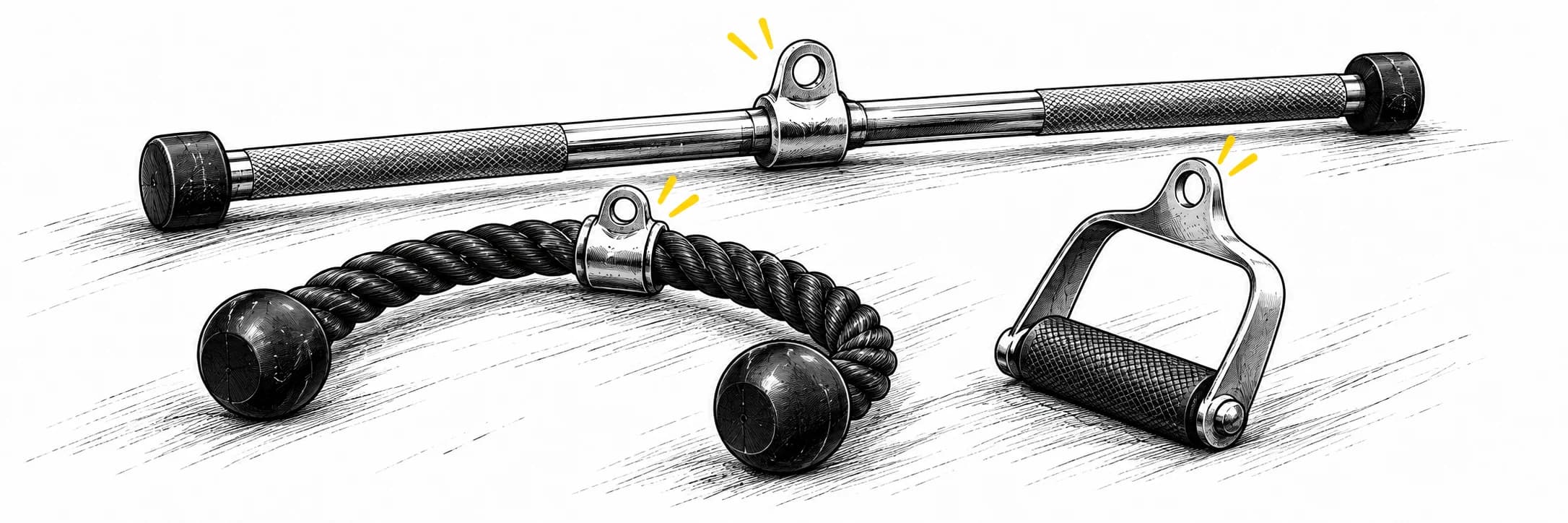
A cable upright row is a resistance exercise in which a low cable attachment is pulled upward in front of the body through shoulder elevation and elbow flexion. Grip, handle and range can be adjusted.
Definition and muscles
The movement generally involves the deltoid, trapezius and elbow flexors, while other shoulder and trunk muscles control the path. A study of free-weight upright rows in 16 trained men found that wider grips increased acute deltoid and trapezius EMG and reduced biceps activity relative to narrower grips. That study did not test cables or show long-term growth, strength, endurance or safety.
McAllister et al. · upright-row grip-width EMG study
Setup and technique
Attach a suitable handle to a low cable, select a manageable load and stand with a stable stance. Pull upward through a comfortable path, then lower under control. Handle type, grip width, elbow height, distance from the body, pause, tempo and breathing can vary. A chin-height finish, elbows above the shoulders, one-second hold and two-second lowering phase are coaching choices rather than universal requirements.
McAllister et al. · upright-row grip-width EMG study · ACSM · resistance-training prescription position stand
Grip, range and shoulder comfort
Shoulder elevation combines motion at the glenohumeral, scapulothoracic, acromioclavicular and sternoclavicular articulations. One shoulder-width grip or chin-height stopping point has not been shown to prevent “impingement” for everyone, and no upright-row variation is automatically safe for every shoulder. Use a symptom-free range and adjust grip, handle, load or exercise when pain or pinching occurs; persistent symptoms merit assessment.
Michener et al. · shoulder impingement biomechanics review
Cable versus barbell
A cable changes the direction of external force across the movement and a barbell remains governed by gravity, but “constant tension” does not establish a superior strength curve, endurance effect or lower joint stress. Longer-term comparisons of machines and free weights generally find similar hypertrophy and neutral-test strength, with strength gains specific to the trained mode. Choose equipment for the goal, access, control and comfort.
Haugen et al. · free weights versus machines meta-analysis
HYROX® relevance
Wall Balls and Farmers Carry appear in HYROX® Singles, but their task demands differ from an upright row. This exercise can be used as general shoulder training; no direct evidence reviewed here shows that it improves either station or supports a fixed 2–3×10–12 HYROX® prescription. Practice the stations and program accessory work according to the broader plan.
HYROX® Singles Rulebook 2026/27 · ACSM · resistance-training prescription position stand
Frequently Asked Questions
Is a cable upright row safer than a barbell upright row?
No comparative evidence reviewed here establishes that. The force profile and feel differ, while comfort depends on the individual, setup, load and range.
Haugen et al. · free weights versus machines meta-analysis · Michener et al. · shoulder impingement biomechanics review
How high should I pull?
Use the highest range you can control without pain or unwanted compensation; chin height is not required. Reduce the range or choose another exercise if symptoms occur.
Michener et al. · shoulder impingement biomechanics review · ACSM · resistance-training prescription position stand
Marketing text preserved unchanged
Built for hybrid athletes, Repz turns your goal time and equipment into a smarter HYROX® training week. See plans, exercises, and pacing guides at repz.app.
Was this helpful?