Hip Hinge
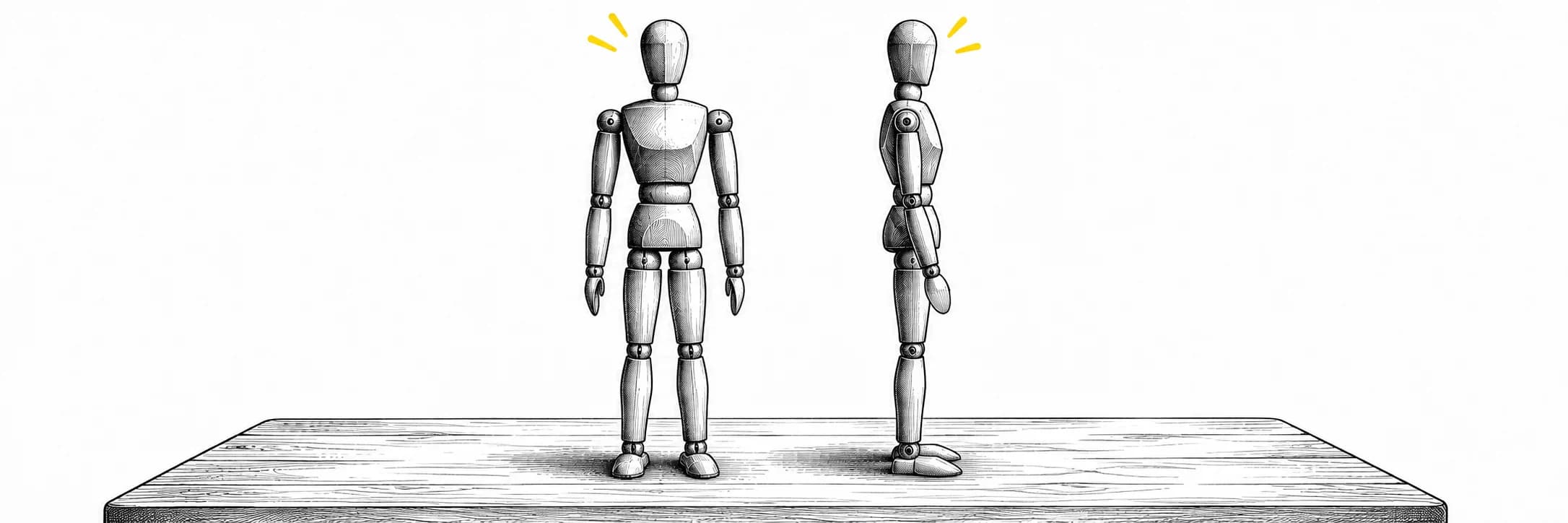
Hip Hinge — A fundamental movement pattern where you bend at the hips while keeping a neutral spine. The foundation for deadlifts, rowing, kettlebell swings, and HYROX® sled work.
Definition
Hip hinge is a coaching term for movement dominated by hip flexion and extension while the trunk inclines. It commonly appears in deadlift and Romanian-deadlift variations. It is not a single joint-only action: knee, pelvis and spine positions vary with the exercise, anatomy, load, intent and experience. Gluteal, hamstring and trunk muscles can contribute, but their relative contribution is task-dependent.
Ramirez et al. repetitive-deadlift biomechanics review
Hinge, squat and task context
A hinge generally uses more posterior hip displacement and less knee travel than a squat, while a squat generally uses more knee flexion. They are points on a movement spectrum rather than perfectly separate patterns. Torso parallel to the floor, minimal knee bend, a hamstring stretch and three dowel contacts are coaching checks, not universal pass/fail standards or medical tests.
Ramirez et al. repetitive-deadlift biomechanics review
HYROX® relevance
The current Singles race contains no scored “hip hinge” repetition. Rowing uses coordinated ankle, knee, hip, pelvis and trunk motion; a systematic review found kinematic differences between rowers with and without low-back pain, but its observational evidence does not prove that one hinge error causes pain. Sled work, picking up carry implements and ergometer strokes involve task-specific positions, so practising a Romanian deadlift does not automatically optimise every station.
HYROX® Singles Rulebook 2026/27 · Nugent et al. rowing biomechanics and low-back-pain systematic review
Learning and loading the pattern
A wall-touch or dowel drill can provide external feedback, and deadlift, RDL or swing variations can train different strength or power qualities. Select range, load, repetitions and frequency for the exercise and athlete, and progress them gradually. Heavy deadlifts create substantial spinal loads, while evidence on repetitive deadlift biomechanics and injury remains limited. Pain, neurological symptoms or recurring back problems require individual clinical assessment rather than a generic “neutral spine” correction.
Ramirez et al. repetitive-deadlift biomechanics review · ACSM 2026 resistance-training position stand
Frequently Asked Questions
What is the difference between a hinge and squat?
A hinge usually emphasises hip displacement with less knee flexion; a squat usually uses more knee flexion. Actual exercises combine hip, knee, pelvis and trunk motion to varying degrees.
Ramirez et al. repetitive-deadlift biomechanics review
Does my torso need to reach parallel?
No universal depth applies. Range depends on the exercise, load, mobility, control and goal.
Ramirez et al. repetitive-deadlift biomechanics review
Does a rounded back prove injury risk?
No. Spinal posture changes loading, but posture alone does not diagnose injury risk or explain pain. Use progressive loading and seek assessment for symptoms.
Ramirez et al. repetitive-deadlift biomechanics review · Nugent et al. rowing biomechanics and low-back-pain systematic review
Marketing text preserved unchanged
Lower back giving out during sled work and rows? See where you're losing time and what to train first.
Was this helpful?