Hyrox Sled Push & Pull: Women's Weight Guide
HYROX women’s sled weights 2026/27:Open push 102 kg/pull 78 kg, Pro push 152 kg/pull 103 kg. Official lane rules and optional training progression.
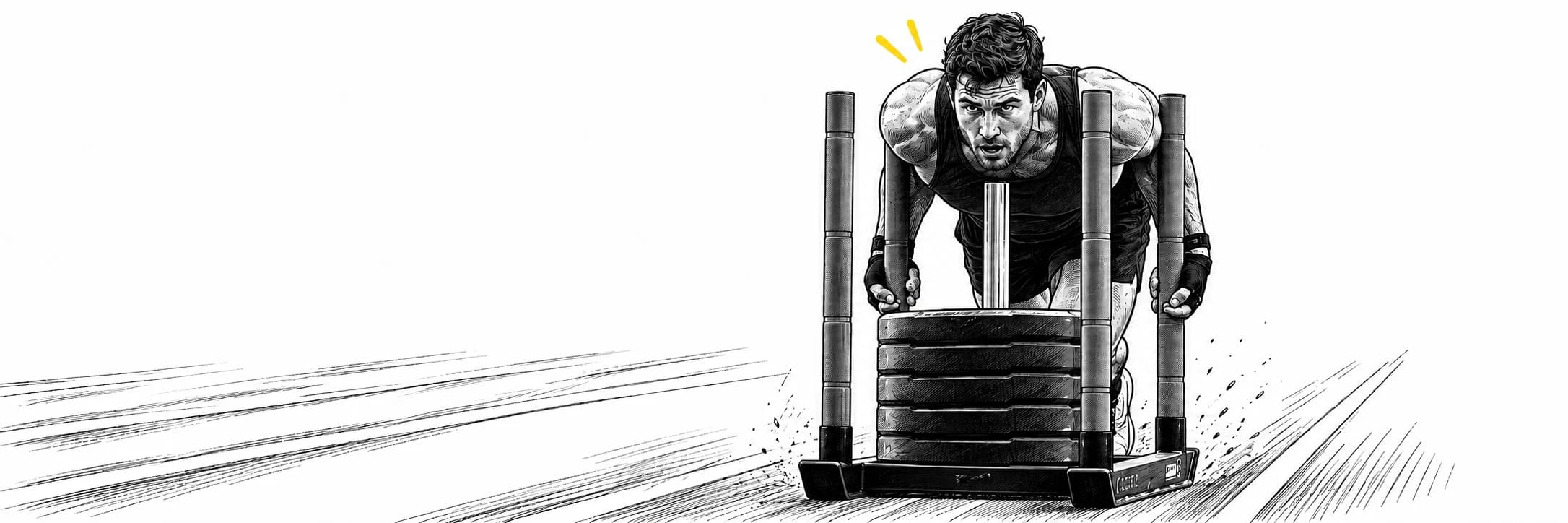
Exact sled weights for women
The current standard Singles weights are below. The published number is the loaded total, including the sled frame and plates; it is not the number of kilograms of plates to add. Singles 4.1 and 8.2–8.3, pp 8 and 27–28.
| Division | Sled push | Sled pull | Distance at each station |
|---|---|---|---|
| Women / Open | 102 kg | 78 kg | 4×12.5 m=50 m |
| Women Pro | 152 kg | 103 kg | 4×12.5 m=50 m |
These rows describe regular Singles. Women’s Doubles uses 102/78 kg and Women Pro Doubles 152/103 kg, shared as team work. In Mixed Doubles both partners use 152 kg for the push and 103 kg for the pull. Your entry category determines the table to use. Doubles 4.1, p 8; 7.2, p 24.
For more on the station, see the sled push guide and sled push technique article.
Where the sled stations occur
The opening sequence is run 1 → 1,000 m SkiErg → run 2 → sled push → run 3 → sled pull. You have therefore completed two designated running segments before the push, not one. The race design has 8,000 m of running overall; individual segments can vary around 1 km with the venue layout. Singles 1, p 4; 7–7.2, pp 22–24.
Use that order when planning a rehearsal. A short run-to-push drill is an optional training segment, not a full simulation of everything preceding station 2. It does not need to replace every fresh technique session.
Push: complete each length legally
Use the lane assigned by the judge. Both you and the sled start completely behind the white line. Stay in your lane and avoid interfering with adjacent lanes. Before changing direction, the entire sled must pass the 12.5 m line. The station ends after four completed lengths and the whole sled has crossed the final line. Singles 8.2, p 27.
The movement standard does not prescribe a universal 45-degree body angle, locked elbows or one stride cadence. Treat your position as something to practise with the actual equipment, rather than a mandatory angle determined by being a woman or being taller than 175 cm. Singles 8.2, p 27.
Pull: the working box matters
For the pull, begin with you and the sled in the designated Racers Box. Remain standing in the working space; you may not pull while kneeling or sitting. While holding the rope, do not step on the solid front or rear line of the box. Keep the rope in your lane; it may extend behind the lane but must not impede a neighbouring lane. Singles 8.3, pp 27–28.
Pull the entire sled beyond the 12.5 m line before changing ends, then run to the opposite end to pull it back. Complete four lengths. This is not an unrestricted 50 m backward walk with a rope over your shoulder. Both sled stations use a warning/15-second penalty protocol for movement infringements, with a further 15 seconds for subsequent infringements; severe violations may be penalised immediately under the general rule. Singles 8.2–8.3, pp 27–28; 12.5, p 44.
Why kilograms alone do not reproduce the race
A sled-towing experiment with six male rugby players found that surface friction affected loading and sprint performance. It did not test women doing HYROX® or establish a gym-to-race conversion factor. Matching kilograms alone therefore should not be treated as proof of an identical task. Linthorne and Cooper 2013, abstract.
For your training log, record the sled’s total mass, surface, distance, number of starts and rests. Compare repeated efforts on the same setup before interpreting a different gym’s number. These are practical comparison suggestions, not a formula for calculating your race split.
An optional progression, without fixed deadlines
Start with a manageable load and rehearse the start line, full sled crossing and change of ends. Add repetitions or load only when you can still complete the planned movement and keep control. A coach can help choose a progression from your current capacity and overall training schedule.
Next, practise the four 12.5 m lengths at a load appropriate to your preparation. Keep fresh technique work and optional run-to-station combinations as different session choices. Record the effort and recovery you actually need; there is no eight-week deadline or two-session weekly rule established by the race regulations.
Heavier-than-race sled work is a possible programming choice, not a requirement for every athlete. This guide does not prescribe 120% of race weight or promise that it guarantees easier racing, better technique or faster recovery. Likewise, it does not infer shoulder instability or a specific muscle imbalance from sex or height alone.
The pacing study previously cited here examined 13 male CrossFit competitors doing Fight Gone Bad. It does not establish a HYROX® women’s RPE 7 target, a 10–15 s/km adjustment, a 20–45 second post-sled loss or a 120%-load programme. Ribeiro et al. 2024, abstract.
Optional further reading: sled push workouts, training for women, 12-week training plan, HYROX® workout guide and strength training for women.
What changes from Open to Pro
The push increases by 50 kg: 152−102. That is about 49.0% more total mass. The pull increases by 25 kg: 103−78, or about 32.1%. These are calculations from the official table, not percentages of strength an athlete must gain or predictions of how many months preparation will take. Singles 4.1, p 8.
Assess your choice using the actual division loads, your practice and your overall race preparation. Completing Open does not establish a universal readiness date for Pro. See the race tips for women for further planning topics.
FAQ
What is the current sled push weight for women?
In standard 2026/27 Singles, Women / Open push 102 kg and Women Pro push 152 kg, including the sled. Both complete four 12.5 m lengths, totalling 50 m.
How does the women’s sled pull weight compare?
Women / Open pull 78 kg and Women Pro pull 103 kg, including the sled. The respective push totals are 102 kg and 152 kg, so the differences are 24 kg and 49 kg.
Must I train at 120% of race weight twice a week?
No such training prescription is established by the race regulations or the studies cited here. Choose training load, frequency and progression for your current capacity and total programme; heavier work is an option, not a universal requirement.
Was this helpful?
Related Articles
12-Week HYROX Training Plan for Women: Open
Prepare for women's Open HYROX with verified 2026/27 station standards, a 12-week calendar, a four-day schedule and practical load and recovery guidance.
hyrox race day womenHyrox Race Day Guide for Women
A complete HYROX® race day guide for women — from warm-up to the finish line. Pacing, station tactics, and the mental strategy Repz athletes use.
hyrox strength training womenHyrox Strength Training for Women: Key Exercises
Build the right strength for HYROX® as a woman. Repz covers the exact movement patterns, loading progressions, and session structures you need.
Know Where You Stand
Reading is good. Training with a plan built around your weaknesses is better. Get Repz and turn what you just read into your next session.