Combined Push & Pull Workout
Master push and pull sled techniques with our complete HYROX® training guide. Get proper form tips, weight standards, and progressive workouts for race success.
What the race requires
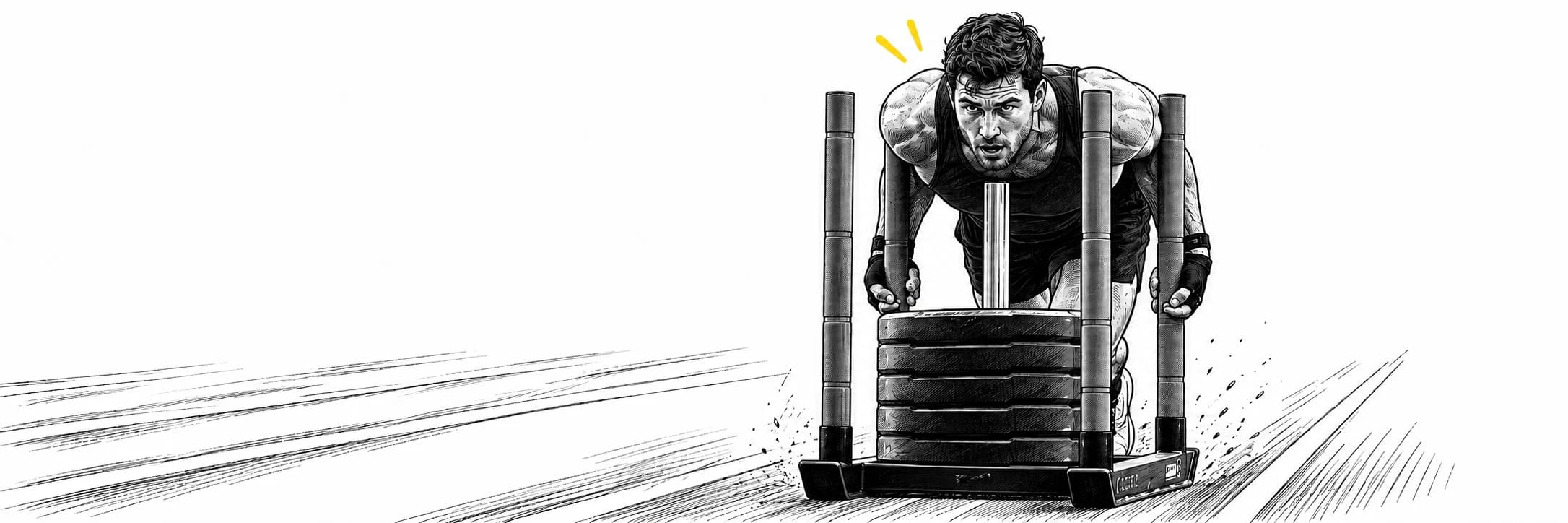
In current Singles races, Sled Push is station two and Sled Pull is station three. A 1 km run separates them. Each station covers 50 m as four 12.5 m lengths. Total loads including the sled are: Push—Women 102 kg, Women Pro and Men 152 kg, Men Pro 202 kg; Pull—Women 78 kg, Women Pro and Men 103 kg, Men Pro 153 kg. Surface friction affects the force required, so loaded mass alone does not make two setups equivalent.
HYROX® Singles Rulebook 2026/27
Why combined practice can be useful
Practising a push, a run and a pull in race order can familiarise an athlete with transitions and reveal whether technique remains rule-compliant under fatigue. It does not prove that this sequence is where races are decided, that specific muscles remain depleted, or that fixed heart-rate, lactate or recovery values apply. Training effects are task-specific, and evidence does not establish one HYROX® combo protocol as superior.
Saeterbakken et al. training-specificity meta-analysis · ACSM 2026 resistance-training position stand
An adjustable practice session
After a warm-up, choose a sled load that allows controlled, rule-compliant movement on the available surface. Complete one or more short push lengths, an individually chosen run, then one or more pull lengths. Rest enough to repeat with stable technique. Record the actual sled, added plates, surface, distance, time and perceived effort. This is a coaching framework, not a validated prescription; distance, load, rounds and rest should match experience, health, phase and the rest of the programme.
ACSM 2026 resistance-training position stand · Cahill et al. sled-push load–velocity study
Progression and safety
Progress one variable at a time when appropriate: distance, load, rounds, speed or shorter rest. Because load–velocity response varies greatly between athletes and surfaces, fixed percentages of race mass do not impose the same demand on everyone. Stop when technique or rule compliance deteriorates materially, or if pain, dizziness or unusual symptoms occur. Use suitable equipment and clear lanes; rope work needs enough space to avoid entanglement.
Cahill et al. sled-push load–velocity study · ACSM 2026 resistance-training position stand
Frequently Asked Questions
Must I train push and pull together?
No. Combined practice is an optional way to rehearse sequence and transitions; separate strength and technique sessions can also have a place.
ACSM 2026 resistance-training position stand · Cahill et al. sled-push load–velocity study
Should every session use race weight?
No. Choose load from the session goal, surface, equipment and current ability. Race mass on a different surface may not reproduce race resistance.
ACSM 2026 resistance-training position stand · Cahill et al. sled-push load–velocity study
How often should I do combo sessions?
No universal once- or twice-weekly rule is established. Fit demanding sled work around recovery, running and the rest of the programme.
ACSM 2026 resistance-training position stand · Cahill et al. sled-push load–velocity study
Do Doubles athletes each complete exactly 25 m?
No. Partners may divide station work as permitted by the current Doubles rules; the Singles rulebook does not establish a mandatory half-and-half split.
Was this helpful?
Related Articles
Grip Training for Sled Pull
Prepare your grip for the HYROX Sled Pull: current rope specifications, training options, chalk and glove rules, and practical skin care.
sled pull exerciseSled Pull for Beginners
Beginner’s guide to the HYROX Sled Pull: current Singles weights, four 12.5 m lengths, a practical learning progression and equipment alternatives.
sled pull workoutSled Pull Workouts for Hyrox
Sled Pull workouts for HYROX Singles: current station rules and loads, optional practice sessions, and guidance for choosing manageable training demands.
Know Where You Stand
Reading is good. Training with a plan built around your weaknesses is better. Get Repz and turn what you just read into your next session.