Wall Ball Pacing: Rep Schemes
Master wall ball pacing with proven rep schemes. Learn optimal breakdowns, heart rate management, and recovery techniques to avoid burnout in HYROX® races.
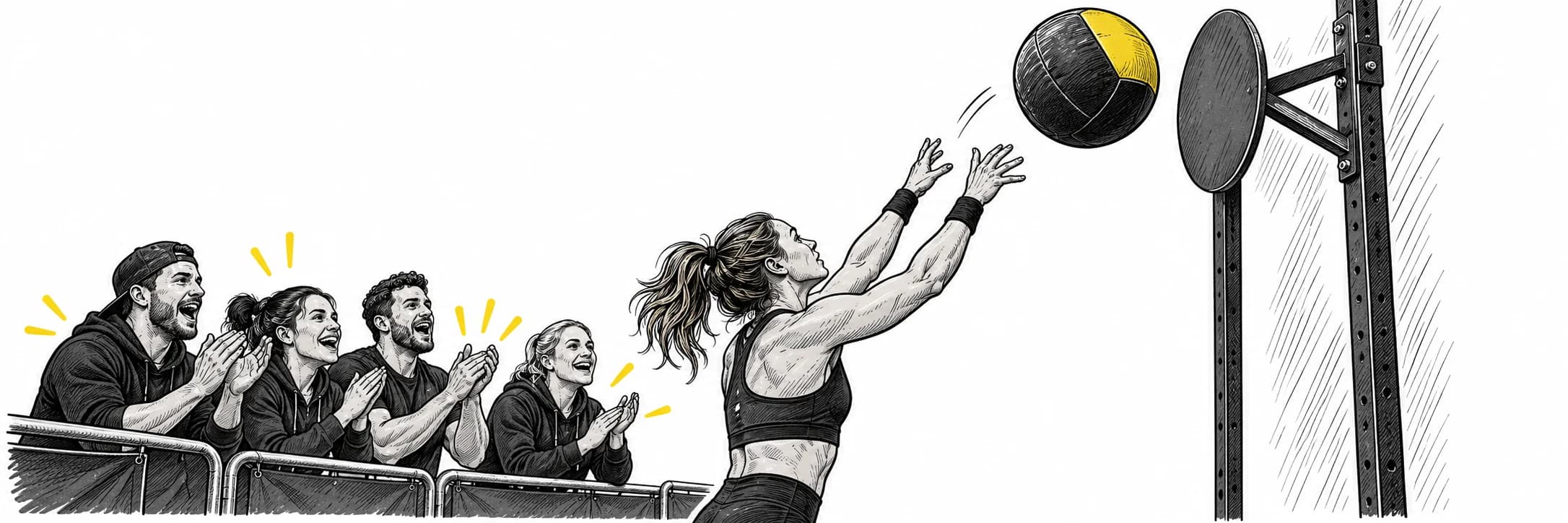
Current HYROX® Wall Ball rules
Wall Balls are station eight after the eighth 1 km run. Current Singles requires 100 repetitions in every division. Women uses a 4 kg ball to a 2.70 m target; Women Pro uses 6 kg to 2.70 m; Men uses 6 kg to 3.00 m; Men Pro uses 9 kg to 3.00 m. A valid repetition requires the prescribed squat depth and the ball to contact the correct target. Follow the judge and current briefing; a missed target, insufficient depth or other rule violation can be called a no-rep.
HYROX® Singles Rulebook 2026/27
A beginner setup
Use the correct target and a ball whose mass is suitable for the current learning stage. Stand far enough from the wall to squat and throw without collision, but no single heel-to-wall distance or stance width fits every athlete. Foot angle, stance, limb proportions, ankle motion and target height change the movement. Begin with a controllable ball and legal target practice, then progress toward division standards rather than learning through repeated uncontrolled misses.
HYROX® Singles Rulebook 2026/27 · Straub and Powers 2024 squat biomechanics review
Squat, drive, throw and catch
Receive the ball under control, descend to the required position, stand and direct the ball to the target. The legs, trunk and arms contribute, but no reviewed evidence assigns a fixed percentage or proves one universal sequence cue. Let the next repetition begin only when balance and ball path are controlled. Catch height and tempo can vary; forcing a low catch or immediate rebound while control is lost is not required by the rules.
HYROX® Singles Rulebook 2026/27 · Straub and Powers 2024 squat biomechanics review
Common no-reps and controllable errors
The current rule is not simply “below parallel”: the crease of the hip must clearly pass below the top of the knees before the athlete stands and throws. Other frequent issues are missing the correct target, releasing from an unstable position or losing the ball path. Looking down, a particular knee path or a pause between repetitions is not automatically a no-rep. Use video or a coach to compare the movement with official criteria instead of applying cosmetic rules unsupported by the rulebook.
HYROX® Singles Rulebook 2026/27 · Straub and Powers 2024 squat biomechanics review
Progressing training
Build skill with small sets, then increase total repetitions, ball mass, target height or placement after running when the current dose is controlled. Race planning can organize practice but does not guarantee performance. No trial validates the original exact 70% start, sub-ten-second rests, 25-25-20-15-15 split, unbroken finish, negative split or mandatory fatigue simulation. Use recovery, symptoms, no-rep rate and technique consistency to adjust volume.
ACSM 2026 resistance-training position stand
Breathing and set strategy
Breathe continuously using a pattern that can be sustained; there is no proven universal inhale-on-catch and exhale-on-throw requirement. Plan sets from practice and current capacity rather than copying 25-20-15-15, sets of ten or an unbroken target. Brief planned pauses can be useful if they reduce no-reps, while uncontrolled breath holding, dizziness or sharp pain are reasons to stop and reset.
ACSM 2026 resistance-training position stand
Alternatives and specificity
Thrusters, medicine-ball squats, goblet squats and air squats can train related leg, trunk or pressing capacities, but they do not reproduce the target contact, ball flight and catch. Task-specificity evidence supports practising legal Wall Balls before racing. Use an alternative when equipment is unavailable, then arrange time with the correct ball and target; do not assume a fixed rep multiplier makes the substitute equivalent.
Saeterbakken et al. resistance-training specificity meta-analysis · ACSM 2026 resistance-training position stand
Evidence limits
Direct evidence for optimal Wall Ball technique or programming in HYROX® is minimal. The published HYROX® study involved only eleven recreational athletes; it found the highest acute measured values at the final Wall Ball station, but cannot establish the original universal station-time claims, causal mechanisms or best set strategy. Squat biomechanics vary with stance, foot position, trunk, tibia and depth. Official rules determine valid reps; broader training evidence supports individual progression.
Brandt et al. 2025 HYROX® simulation study · Straub and Powers 2024 squat biomechanics review
Frequently Asked Questions
How many Wall Balls are in current HYROX® Singles?
One hundred in every division. Ball mass and target height vary by division.
HYROX® Singles Rulebook 2026/27
What are the current ball weights and targets?
Women: 4 kg at 2.70 m; Women Pro: 6 kg at 2.70 m; Men: 6 kg at 3.00 m; Men Pro: 9 kg at 3.00 m.
HYROX® Singles Rulebook 2026/27
Must I squat below parallel?
The current standard requires the crease of the hip to pass clearly below the top of the knees. Use the rulebook wording and judge guidance.
HYROX® Singles Rulebook 2026/27
How should a beginner choose sets?
Start with sets that preserve target accuracy and legal depth. Increase total work or set length from repeated successful practice, not a universal scheme.
ACSM 2026 resistance-training position stand
What can replace Wall Balls?
Other squat-and-press exercises train related capacities but are not equivalent. Practise with the correct ball and target before racing when possible.
Saeterbakken et al. resistance-training specificity meta-analysis · ACSM 2026 resistance-training position stand
How do Doubles partners share Wall Balls?
They may share work with rule-compliant handovers while observing partner-position and movement standards; the exact split is a team strategy.
HYROX® Doubles Rulebook 2026/27
Marketing text preserved unchanged
Marketing text preserved unchanged
The Unbroken Myth: What Repz Data Actually Shows
The reality is more nuanced. Data from Repz's division benchmarks shows that athletes who attempt to go completely unbroken on Wall Balls complete the station in roughly the same time as athletes who break the 100 reps into structured sets of 15–20 reps with short rest intervals.^2
Sets of 15 reps are the anchor point for this group. Start with a set of 15, rest 8–10 seconds, then continue with sets of 15 until you hit 75, then push through the final 25 as best you can. This is the most commonly successful pattern across Repz data for mid-pack Open athletes. The consistency of 15s creates a rhythm that your body can manage even under fatigue.
Probably not. Being able to do 100 unbroken when fresh does not mean it is the optimal strategy after 7 stations and 8km of running. Repz data shows athletes attempting unbroken Wall Balls finish in similar times to those using structured sets, but the unbroken attempts carry significantly higher risk of blowing up, slowing dramatically, or losing form. Unless you have specifically trained Wall Balls at the end of full race simulations and consistently gone unbroken with strong mechanics, structured sets of 15–20 with 5–10 second rests is the lower-risk, equal-reward approach.
^2 Repz internal analysis of race result recent seasons of race data, examining Wall Ball station completion times segmented by self-reported pacing strategy.
Was this helpful?
Related Articles
Wall Ball Squat Technique
Master wall ball squats with proper depth, drive, and throw technique. Learn HYROX®-specific pacing, weights, and training programs for competition success.
wall balls hyroxWall Ball Race Tips: Hyrox
Master wall balls Hyrox with proven race-day tactics, pacing strategies, and recovery tips. Learn proper technique and transition tactics for optimal performance.
medicine ball vs wall ballMedicine Ball vs Wall Ball: Key Differences
“Medicine ball” and “wall ball” are not reliable universal construction categories. For HYROX, choose equipment by the current division load, target and intended wall-throw use.
Know Where You Stand
Reading is good. Training with a plan built around your weaknesses is better. Get Repz and turn what you just read into your next session.