Wall Ball Endurance Training: 100 Reps
Master wall ball endurance with our 100-rep training protocol. Learn heart rate zones, recovery methods, and periodization for HYROX® competition success.
Start with the current standard
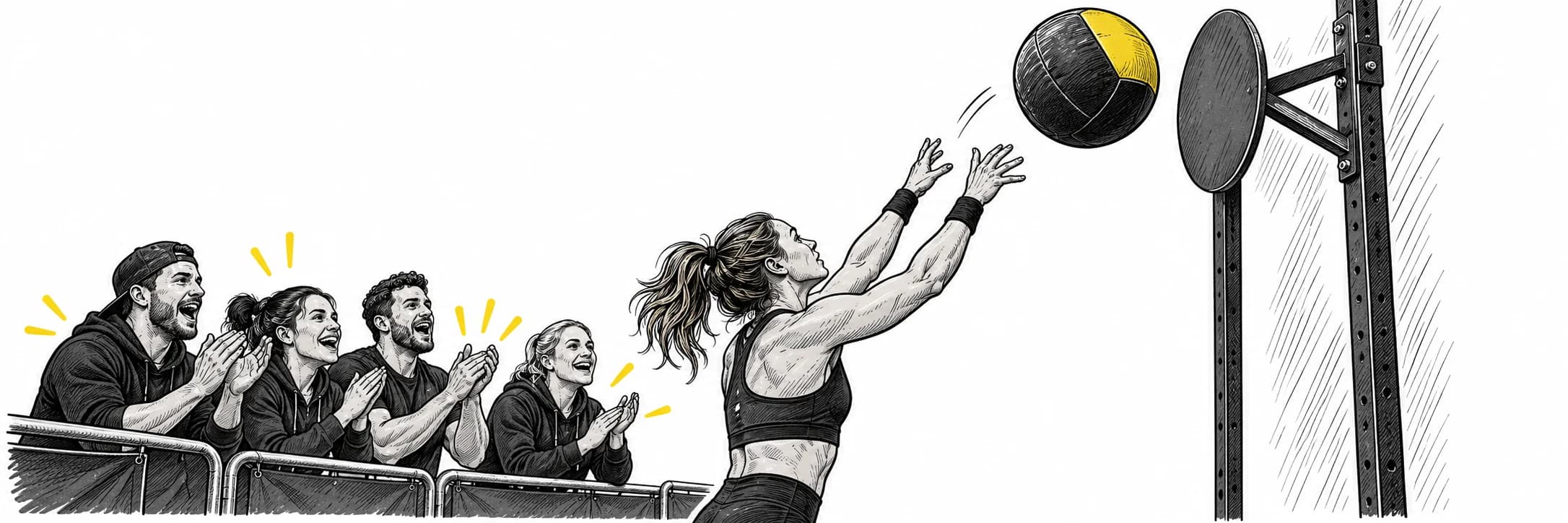
Wall Balls are station 8 after the eighth 1 km run in current Singles, and the athlete completes 100 valid repetitions. Ball mass and target height depend on division: Women Open uses 4 kg to 2.70 m and Men Open 6 kg to 3.00 m, while Pro and some age/category standards differ. Doubles also has its own table and work-sharing rules. Verify the entered rulebook rather than treating “men” and “women” as two universal specifications.
HYROX® Singles Rulebook 2026/27 · HYROX® Doubles Rulebook 2026/27
A valid repetition comes first
A repetition counts only when the squat and throw meet the current movement standard and the ball contacts the prescribed target area. A judge can issue no-reps, which add work. Learn stance, catch, squat depth, throw path and breathing with a manageable ball before chasing speed. Technique may differ between athletes; no single foot width, catch height or breathing rhythm is proven optimal for everyone.
HYROX® Singles Rulebook 2026/27
Choose a session by purpose
One session can prioritise movement quality, another total repeatable volume, another work rate, and a later session transition from running into Wall Balls. These are distinct aims. Labels such as “lactate accumulation” do not establish a specific adaptation, and discomfort is not proof that a protocol improves race performance. Choose the smallest dose that addresses the current limit while preserving valid repetitions.
ACSM 2026 resistance-training position stand · Resistance-training specificity meta-analysis
Five adaptable workout formats
Technique clusters: small sets with full reset and judge-quality reps. Volume sets: accumulate a manageable total with planned rests. Density work: repeat a familiar set within a time window without sacrificing standards. Transition practice: an easy or controlled run followed by a modest Wall Ball set. Partial rehearsal: a submaximal race-relevant total on the correct ball and target. Exact repetitions, time, rest and frequency should follow experience and recovery; none of these formats is a validated universal “core six.”
ACSM 2026 resistance-training position stand
Progress without arbitrary deadlines
Increase one main variable at a time: rep quality, total valid repetitions, ball mass, target requirement, shorter rest or preceding work. Do not assume everyone needs 16 weeks, two weekly sessions, 10% weekly volume or race mass by a fixed date. Repeated sets to failure are not required for adaptation. When no-reps rise or mechanics deteriorate, reduce the demand and rebuild rather than counting invalid practice as useful volume.
ACSM 2026 resistance-training position stand · Resistance-training specificity meta-analysis
Use fatigue carefully
Wall Balls late in a race occur under accumulated fatigue, but repeated maximal chippers can add fatigue without teaching sustainable execution. Introduce race-order work only after the movement is stable when fresh, then use controlled running or selected stations before a limited Wall Ball dose. The small direct HYROX® study describes acute demand in eleven recreational athletes; it does not validate a precise fatigue-entry frequency, prove a lactate mechanism or show that “back-half” overload prevents failure.
Brandt et al. 2025 HYROX® simulation study · Resistance-training specificity meta-analysis
Plan race sets from evidence you collect
Test several sustainable set sizes and rest styles with valid-rep counting. A plan such as 10 × 10, descending sets or smaller clusters is a hypothesis, not a universal best strategy. Choose from training data, expected fatigue and the current judge standard, and keep an option to shorten sets on race day. Unbroken 100 is not required, and a preselected partition cannot guarantee a faster station.
HYROX® Singles Rulebook 2026/27 · ACSM 2026 resistance-training position stand
Frequently Asked Questions
What ball and target should I use?
Use the current standard for your exact division. Women Open and Men Open differ, and Pro, age categories and Doubles may also differ.
HYROX® Singles Rulebook 2026/27 · HYROX® Doubles Rulebook 2026/27
How often should I train Wall Balls?
There is no universal frequency. Fit a tolerable dose into the full running, strength and station programme and adjust from recovery and rep quality.
ACSM 2026 resistance-training position stand · Resistance-training specificity meta-analysis
Should I train 100 repetitions every week?
No. Full totals can be used selectively, but smaller quality, volume or transition sessions may be more appropriate.
ACSM 2026 resistance-training position stand · Resistance-training specificity meta-analysis
Is 10 sets of 10 the best race strategy?
Not universally. Test sustainable partitions and count valid reps; choose a flexible plan from your own evidence.
ACSM 2026 resistance-training position stand · Resistance-training specificity meta-analysis
Do I need to train to failure?
No. Failure is not required, and frequent failure can degrade technique and add recovery cost.
ACSM 2026 resistance-training position stand · Resistance-training specificity meta-analysis
How do Doubles Wall Balls work?
Partners enter the station together and share work one athlete at a time under current changeover rules. Verify the Doubles load, target and standards.
HYROX® Singles Rulebook 2026/27 · HYROX® Doubles Rulebook 2026/27
Marketing text preserved unchanged
Repz recent seasons of race data confirms what experienced coaches already know: Wall Balls is the most time-costly station in a HYROX® race relative to athletes' overall finishing pace. The gap between a well-prepared athlete and one who neglected wall ball endurance specifically can exceed three minutes at this single station. Three minutes, after everything that came before it.
This guide covers what wall ball endurance actually is, how to build it systematically, how to structure the progression from fragmented sets to 100 reliable reps, and how to integrate it into a HYROX® periodization block. For the technique fundamentals that underpin all of this, the HYROX® wall balls pillar guide is the right starting point.
For context on where this sits in a broader training framework, the HYROX® training zones guide explains the zone structure and how to train each system within a full HYROX® block.
The HYROX® training plan guide outlines how to distribute training zones across a full preparation block, including when to emphasize which zone for wall ball work.
The goal is to arrive at race day having completed 100 reps at least 3–4 times in training, so the set count is familiar rather than daunting. For athletes looking at race-specific set structures, wall ball pacing strategies covers the optimal set breakdowns in detail.
For beginners establishing their wall ball foundation before taking on race-specific structures, wall ball training for beginners covers the starting steps.
Nutrition timing: Carbohydrate availability significantly affects wall ball endurance capacity. Training this station in a fasted state for general conditioning has value, but for Phase 3 sessions at race-specific intensity, train fueled. Chronic underfueling during high-intensity training blocks blunts adaptation and extends recovery windows. For detailed context on how the squat mechanics under fatigue interact with nutrition timing, wall ball squat mechanics and training progressions covers the physical demands in depth.
For the full periodization framework across all stations, the HYROX® training plan guide provides a complete block structure with weekly training volumes.
For a broader look at how wall ball sessions fit into full training weeks, wall ball workouts for HYROX® athletes has a structured session library organized by training phase.
Fatigue accumulation across a heavy training block degrades wall ball performance temporarily, and this is normal. Prioritize sleep quality and carbohydrate intake in the days before high-intensity wall ball sessions. In the final two weeks before a race, reduce wall ball training volume by 40–50% while maintaining session intensity. This taper protocol allows the neuromuscular system to recover while preserving the sharpness built across the block. Station 8 race-day tips are covered in depth at wall ball race day execution.
Was this helpful?
Related Articles
Wall Ball Squat Technique
Master wall ball squats with proper depth, drive, and throw technique. Learn HYROX®-specific pacing, weights, and training programs for competition success.
wall balls hyroxWall Ball Race Tips: Hyrox
Master wall balls Hyrox with proven race-day tactics, pacing strategies, and recovery tips. Learn proper technique and transition tactics for optimal performance.
medicine ball vs wall ballMedicine Ball vs Wall Ball: Key Differences
“Medicine ball” and “wall ball” are not reliable universal construction categories. For HYROX, choose equipment by the current division load, target and intended wall-throw use.
Know Where You Stand
Reading is good. Training with a plan built around your weaknesses is better. Get Repz and turn what you just read into your next session.