Wall Ball for Beginners
Master the wall ball with our beginner guide: proper technique, HYROX®-specific pacing strategies, and progression plans for competition success.
Current HYROX® Wall Ball rules
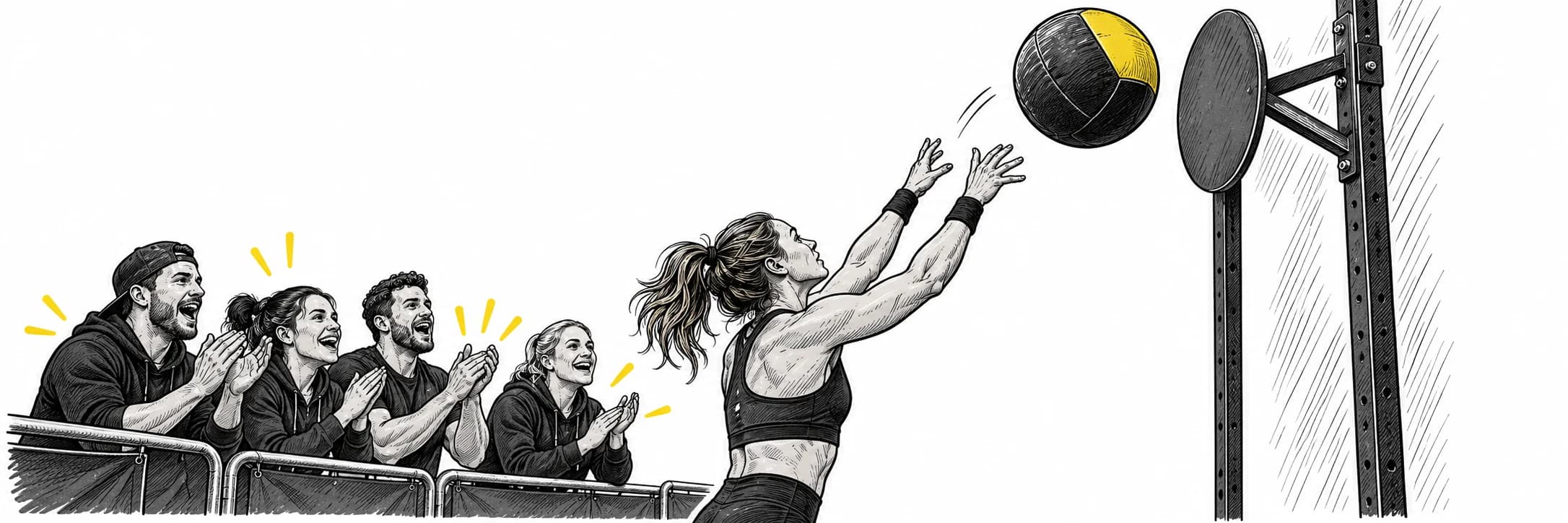
Wall Balls are station eight after the eighth 1 km run. Current Singles requires 100 repetitions in every division. Women uses a 4 kg ball to a 2.70 m target; Women Pro uses 6 kg to 2.70 m; Men uses 6 kg to 3.00 m; Men Pro uses 9 kg to 3.00 m. A valid repetition requires the prescribed squat depth and the ball to contact the correct target. Follow the judge and current briefing; a missed target, insufficient depth or other rule violation can be called a no-rep.
HYROX® Singles Rulebook 2026/27
A beginner setup
Use the correct target and a ball whose mass is suitable for the current learning stage. Stand far enough from the wall to squat and throw without collision, but no single heel-to-wall distance or stance width fits every athlete. Foot angle, stance, limb proportions, ankle motion and target height change the movement. Begin with a controllable ball and legal target practice, then progress toward division standards rather than learning through repeated uncontrolled misses.
HYROX® Singles Rulebook 2026/27 · Straub and Powers 2024 squat biomechanics review
Squat, drive, throw and catch
Receive the ball under control, descend to the required position, stand and direct the ball to the target. The legs, trunk and arms contribute, but no reviewed evidence assigns a fixed percentage or proves one universal sequence cue. Let the next repetition begin only when balance and ball path are controlled. Catch height and tempo can vary; forcing a low catch or immediate rebound while control is lost is not required by the rules.
HYROX® Singles Rulebook 2026/27 · Straub and Powers 2024 squat biomechanics review
Common no-reps and controllable errors
The current rule is not simply “below parallel”: the crease of the hip must clearly pass below the top of the knees before the athlete stands and throws. Other frequent issues are missing the correct target, releasing from an unstable position or losing the ball path. Looking down, a particular knee path or a pause between repetitions is not automatically a no-rep. Use video or a coach to compare the movement with official criteria instead of applying cosmetic rules unsupported by the rulebook.
HYROX® Singles Rulebook 2026/27 · Straub and Powers 2024 squat biomechanics review
Progressing training
Build skill with small sets, then increase total repetitions, ball mass, target height or placement after running when the current dose is controlled. A four-week calendar can organize practice but does not guarantee readiness. No trial validates the original exact weekly sets, 20-repetition threshold, 75-to-100 progression or mandatory fatigue sessions. Use recovery, symptoms, no-rep rate and technique consistency to adjust volume.
ACSM 2026 resistance-training position stand
Breathing and set strategy
Breathe continuously using a pattern that can be sustained; there is no proven universal inhale-on-catch and exhale-on-throw requirement. Plan sets from practice and current capacity rather than copying 25-20-15-15, sets of ten or an unbroken target. Brief planned pauses can be useful if they reduce no-reps, while uncontrolled breath holding, dizziness or sharp pain are reasons to stop and reset.
ACSM 2026 resistance-training position stand
Alternatives and specificity
Thrusters, medicine-ball squats, goblet squats and air squats can train related leg, trunk or pressing capacities, but they do not reproduce the target contact, ball flight and catch. Task-specificity evidence supports practising legal Wall Balls before racing. Use an alternative when equipment is unavailable, then arrange time with the correct ball and target; do not assume a fixed rep multiplier makes the substitute equivalent.
Saeterbakken et al. resistance-training specificity meta-analysis · ACSM 2026 resistance-training position stand
Evidence limits
Direct evidence for optimal Wall Ball technique or programming in HYROX® is minimal. The published HYROX® study involved only eleven recreational athletes; it found the highest acute measured values at the final Wall Ball station, but cannot establish the original universal station-time claims, causal mechanisms or best set strategy. Squat biomechanics vary with stance, foot position, trunk, tibia and depth. Official rules determine valid reps; broader training evidence supports individual progression.
Brandt et al. 2025 HYROX® simulation study · Straub and Powers 2024 squat biomechanics review
Frequently Asked Questions
How many Wall Balls are in current HYROX® Singles?
One hundred in every division. Ball mass and target height vary by division.
HYROX® Singles Rulebook 2026/27
What are the current ball weights and targets?
Women: 4 kg at 2.70 m; Women Pro: 6 kg at 2.70 m; Men: 6 kg at 3.00 m; Men Pro: 9 kg at 3.00 m.
HYROX® Singles Rulebook 2026/27
Must I squat below parallel?
The current standard requires the crease of the hip to pass clearly below the top of the knees. Use the rulebook wording and judge guidance.
HYROX® Singles Rulebook 2026/27
How should a beginner choose sets?
Start with sets that preserve target accuracy and legal depth. Increase total work or set length from repeated successful practice, not a universal scheme.
ACSM 2026 resistance-training position stand
What can replace Wall Balls?
Other squat-and-press exercises train related capacities but are not equivalent. Practise with the correct ball and target before racing when possible.
Saeterbakken et al. resistance-training specificity meta-analysis · ACSM 2026 resistance-training position stand
How do Doubles partners share Wall Balls?
They may share work with rule-compliant handovers while observing partner-position and movement standards; the exact split is a team strategy.
HYROX® Doubles Rulebook 2026/27
Marketing text preserved unchanged
For the full race-day picture (pacing strategies, set structures, Station 8 tactics), the HYROX® wall balls pillar guide covers all of it in depth.
By Week 3, you are training toward the 75–100 rep totals required at HYROX®. Pay attention to whether squat depth shortens in the final reps of each set. That is the most common fatigue-related breakdown in beginners, and it is exactly what leads to no-reps in competition. For a more detailed breakdown of how set structure translates to race performance, wall ball pacing strategies covers the full spectrum from beginner to competitive finishes.
The fatigue-entry session in Week 4 is the single most important adaptation for HYROX® preparation. Wall Balls at Station 8 never happen when you are fresh. Every rep at race day happens after 8km of running and seven prior stations. If you have only ever trained wall balls from a rested state, you have only trained half of what the race requires.[^5] For the full picture of how to integrate this kind of training into a structured HYROX® plan, the HYROX® training plan guide provides a complete periodized block.
For beginners, the goal at their first HYROX® is straightforward: complete the station without stopping. A paused wall ball session where you set the ball down and rest costs 15–30 seconds and, more critically, breaks the physical rhythm that keeps your pace up. Building the capacity to avoid that stop is the primary objective of the progression above. For a full breakdown of workout structures to build that capacity, wall ball workouts for HYROX® athletes is the most comprehensive resource.
For women specifically approaching their first race, the combination of pre-existing fatigue from Station 7 and the required 75 reps makes pacing discipline essential. The wall ball endurance guide covers how to build the specific endurance capacity needed to sustain the final station.
The broader HYROX® training context (how all eight stations fit together, how to weight them in a preparation block, and how to structure running alongside station work) is covered in the HYROX® workout guide.
Wall targets for medicine ball throws: If the full squat movement is unavailable, practicing the throw-and-catch component against a wall at the correct height with any ball builds target accuracy and catch coordination independently. Combine with goblet squats in the same session for a complete substitute. For a comprehensive comparison of wall ball training alternatives and their specificity, wall ball alternatives covers each option in detail.
For a deep technical breakdown of squat mechanics specific to wall ball performance (including common mobility restrictions, breathing patterns, and how squat depth affects throw trajectory), the wall ball squats guide has the full detail.
Have a set structure decided before you arrive at the station. For most first-time Open athletes, sets of 10–15 reps with 8–10 second standing rests (ball held at chest, not set on the floor) is a realistic starting framework. Arriving at the station with a plan means you are not making decisions under oxygen debt and accumulated fatigue. Enter at 70–75% effort on the first set, not all-out. Your second and third sets will be more controlled, which is far better than burning through the first 30 reps and grinding to a halt at rep 50. The HYROX® wall balls pillar guide covers race-day set structures and station tactics in full detail.
Was this helpful?
Related Articles
Wall Ball Squat Technique
Master wall ball squats with proper depth, drive, and throw technique. Learn HYROX®-specific pacing, weights, and training programs for competition success.
wall balls hyroxWall Ball Race Tips: Hyrox
Master wall balls Hyrox with proven race-day tactics, pacing strategies, and recovery tips. Learn proper technique and transition tactics for optimal performance.
medicine ball vs wall ballMedicine Ball vs Wall Ball: Key Differences
“Medicine ball” and “wall ball” are not reliable universal construction categories. For HYROX, choose equipment by the current division load, target and intended wall-throw use.
Know Where You Stand
Reading is good. Training with a plan built around your weaknesses is better. Get Repz and turn what you just read into your next session.