Dumbbell Incline Fly
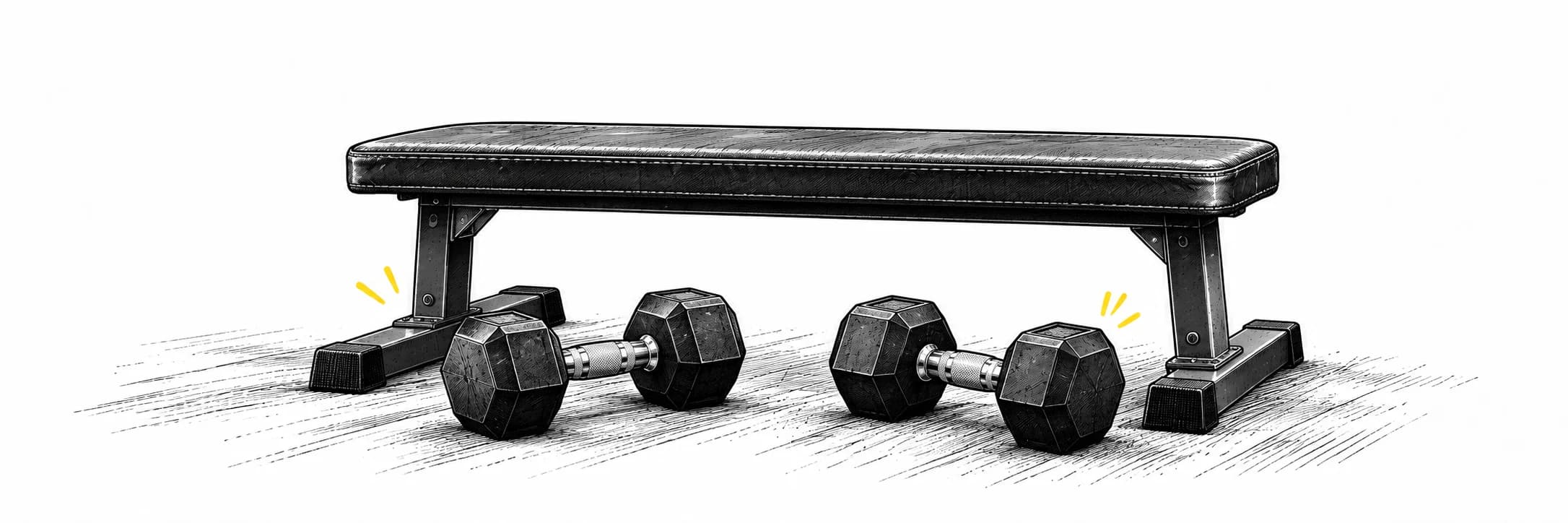
The dumbbell incline fly isolates the upper chest on an incline bench, building pectoral endurance for HYROX wall balls and overhead pressing.
Definition and anatomy
A dumbbell incline fly is a single-joint-dominant resistance exercise performed supine on an inclined bench. With the elbows kept somewhat flexed, the arms move apart and back together around the shoulder while each dumbbell remains independently loaded. The pectoralis major has clavicular and sternocostal parts and contributes to movements including humeral adduction and internal rotation. The anterior deltoid and other shoulder muscles also contribute or stabilise. “Upper chest” is a useful regional description, but the exercise does not isolate one part of the pectoralis.
StatPearls pectoralis-major anatomy review
What EMG and angle studies show
One small experiment measured pectoralis-major and anterior-deltoid surface EMG during inclined fly repetitions at several loads in 11 males; it did not compare bench angles or measure muscle growth. Separate high-density EMG work in eight participants found that changing a bench press from flat to 45 degrees shifted the distribution of larger signals toward the clavicular region. That press study cannot establish the best fly angle, and acute EMG amplitude does not prove regional hypertrophy, flexibility, injury risk or HYROX® transfer.
Rodrigues et al. incline-fly EMG study · Cabral et al. high-density EMG bench-angle study
Execution and shoulder loading
Use a stable bench and dumbbells you can control. Begin above the chest with palms generally facing each other and elbows comfortably flexed. Lower the arms in an arc only through a shoulder range that remains controlled and tolerable, then reverse the path without bouncing. The upper arms do not need to become level with the torso, the elbow angle need not be perfectly fixed, and straightening an elbow does not by itself turn a fly into a press. A 30–45-degree bench, prescribed breathing and a 3-second down/1-second up/1-second squeeze are options rather than universal rules. Because the external moment at the shoulder changes across the arc, load and range should be progressed conservatively. Stop for sudden pain, weakness, bruising or a tearing sensation and seek assessment.
Korakakis et al. resistance-training technique review · StatPearls pectoralis-major anatomy review
Programming for adaptation
Resistance training can increase muscle size and strength when it is progressive and sufficiently challenging. No reviewed evidence establishes 5–12 kg per dumbbell, a mandatory exercise order, a “finisher” role or 2–3 sets of 12–15 as the best fly prescription. Select load, repetitions, sets, tempo and frequency in relation to experience, other chest and shoulder work, recovery and the intended outcome. The fly is one option; hypertrophy does not require this particular exercise or both flat and incline versions.
ACSM 2026 resistance-training position stand · Korakakis et al. resistance-training technique review
HYROX® context
The current Singles race contains no dumbbell fly or incline bench. Wall Balls are a squat-and-throw task with division-specific ball and target standards; the rulebook does not describe a chest “catch” test. No reviewed trial shows that incline flies improve Wall Ball performance, overhead pressing, shoulder range or station endurance. General resistance training may develop relevant capacity, but transfer is strongest to the trained task, so race preparation still requires appropriately scaled practice of the actual movements.
HYROX® Singles Rulebook 2026/27 · Saeterbakken et al. training-specificity meta-analysis
Variations and alternatives
A flat dumbbell fly changes torso orientation but still trains shoulder movement under independent dumbbell load. An incline dumbbell press adds substantial elbow extension and permits a different loading pattern. A pullover uses a different shoulder path and also involves other muscles. None guarantees “overall”, “complete” or more functional chest development; choose according to goal, available equipment and tolerable range.
StatPearls pectoralis-major anatomy review · Saeterbakken et al. training-specificity meta-analysis
Frequently Asked Questions
What bench angle should I use?
There is no proven universally optimal fly angle. Choose a stable incline that lets you control the intended shoulder movement without symptoms; changing the angle also changes demands on the pectoralis and deltoid.
Rodrigues et al. incline-fly EMG study · Cabral et al. high-density EMG bench-angle study
How deep should I lower the dumbbells?
Only as far as you can control comfortably. Reaching torso level or a maximal stretch is not required, and more depth is not automatically better.
Korakakis et al. resistance-training technique review · StatPearls pectoralis-major anatomy review
Will incline flies improve Wall Balls?
A direct benefit has not been demonstrated. Incline flies train a chest-and-shoulder resistance task; Wall Balls require specific squat, throw, target and pacing practice.
HYROX® Singles Rulebook 2026/27 · Saeterbakken et al. training-specificity meta-analysis
Marketing text preserved unchanged
Track your chest accessory work and pressing volume with Repz.
Was this helpful?