Hyrox 1,000m Row Pacing Guide
HYROX rowing pacing: understand 500 m splits, practise a personal race pace, check the damper and follow the current station rules.
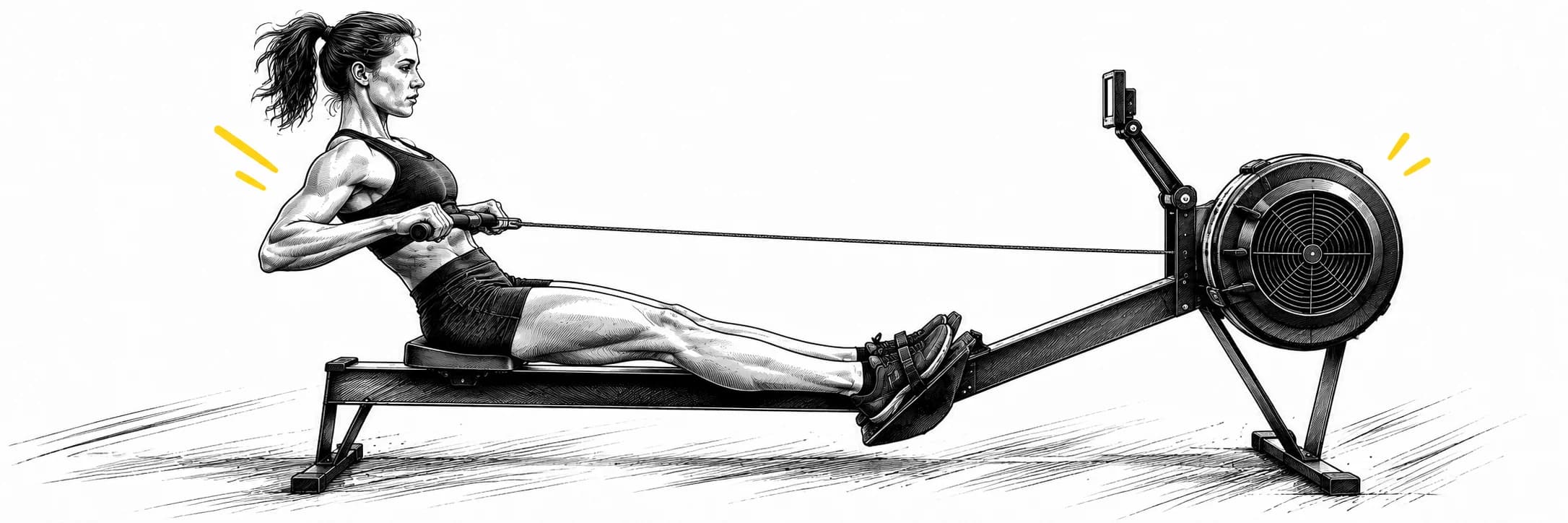
Place rowing in the race
In standard Singles, the sequence is Burpee Broad Jumps, run 5, the 1,000 m row, run 6 and Farmers Carry. Rowing is the fifth of eight workout stations. The sixth run separates it from Farmers Carry; there is no direct 15-second station-to-station transfer prescribed in the rules.
HYROX® Singles 26/27 · §1 / §8.5
Read the split correctly
The Concept2 monitor expresses rowing pace as time per 500 m. For a 2,000 m result, divide the total time by four to obtain the average split: 7:00 gives 1:45/500 m and 8:30 gives 2:07.5/500 m. For 1,000 m, an average of 2:00/500 m gives 4:00; 2:15 gives 4:30; 2:30 gives 5:00. These are arithmetic conversions, not division benchmarks or recommended targets.
Build a personal pacing plan
Use your own training observations to choose a starting pace. As a coaching option, record your average split, perceived effort and technique during a controlled row, then compare another session that includes running before and after the row. Adjust the next attempt from those observations. This is a practice method, not a validated conversion from a fresh 2,000 m personal best. The studies discussed below do not establish a universal addition of 10–15 seconds per 500 m, a temperature cutoff or a target heart-rate zone for this station.
Brandt et al. (2025) · Winkert et al. (2022) · Jones & Vanhatalo (2017)
Even pace or a negative split?
A negative split means completing the second equal-distance half faster than the first. For example, 2:20 for the first 500 m and 2:15 for the second totals 4:35. Two halves of 2:17.5 give the same total with even pacing. You can compare these approaches in training and record the following run as well. The cited studies do not demonstrate that a negative split at HYROX® station 5 saves a fixed number of seconds. Treat a gradual finish as a coaching option, not a guaranteed advantage.
Brandt et al. (2025) · Jones & Vanhatalo (2017)
Set the damper
The Singles rulebook specifies a preset damper of 6 and allows the athlete to adjust it. Concept2 explains that the lever controls airflow; your pulling effort determines intensity. The same lever number need not give the same drag factor on different machines because conditions and cleanliness affect airflow. Concept2 suggests trying 3–5 when learning, but that is general training advice, not a HYROX® rule or a setting assigned by sporting background. Practise with a setting you can use comfortably.
HYROX® Singles 26/27 · §1 / §8.5 · Concept2 · Damper Setting
Keep the stroke organised
Concept2 teaches a drive initiated by the legs, followed by the body and then the arms. Recover by extending the arms, hinging forward and bending the knees after the hands clear them. Keep the grip relaxed and wrists flat. Stroke rate counts strokes per minute; it does not by itself establish pace or effort. Increasing the rate by two or three strokes does not guarantee a particular faster split at unchanged effort.
Concept2 · Rowing Technique · Concept2 · PM5
Finish the station correctly
In Singles, the judge resets the monitor. Remain seated until you have completed 1,000 m and the judge confirms completion. Return the handle to its holder. The feet must be in the foot supports, with straps optional. The foot-support preset is 4 and may be adjusted before rowing. After leaving the station, follow the course into run 6 before Farmers Carry. The rules do not prescribe five breaths, leg shakes or a fixed transfer time.
HYROX® Singles 26/27 · §1 / §8.5
What the research establishes
Brandt and colleagues (2025) examined acute responses in 11 recreational athletes during a simulated HYROX® event. That study did not compare the proposed pacing formulas. Winkert and colleagues (2022) studied energy expenditure and substrate use in 14 elite male rowers using repeated laboratory tests; it was not a study of HYROX® station 5. Jones and Vanhatalo (2017) reviewed critical power and intermittent exercise. Their review does not establish a specific HYROX® split adjustment or a guaranteed negative-split benefit. These sources offer context, but they cannot supply the missing evidence for those precise prescriptions.
Brandt et al. (2025) · Winkert et al. (2022) · Jones & Vanhatalo (2017)
Doubles needs its own plan
Doubles covers 1,000 m as a team; the rulebook does not mandate 500 m per person. There is an unresolved wording conflict in the current 26/27 PDF: section 7.2 describes sharing rowing, including a 250 m example, while section 8.5 says the athlete must remain seated until 1,000 m is completed. Confirm the changeover procedure with the event officials. A universal 500 m-per-person pacing formula would conceal that issue.
HYROX® Doubles 26/27 · §7.2 / §8.5
FAQ
How many seconds should I add to my fresh 2,000 m split?
The sources reviewed here do not validate a universal addition. Use your own practice observations to choose and refine a target. Dividing a 2,000 m time by four calculates its average 500 m split; it does not predict your HYROX® pace.
Concept2 · PM5 · Brandt et al. (2025) · Winkert et al. (2022)
Is a negative split always faster?
No fixed advantage is established by the cited studies. A negative split means a faster second equal-distance half. Compare pacing options in training and include the following run in your observations.
Brandt et al. (2025) · Jones & Vanhatalo (2017)
Which damper setting applies in HYROX® Singles?
The current Singles rulebook specifies a preset of 6 and permits adjustment. Concept2’s general suggestion to try 3–5 is training guidance, not a compulsory race setting.
HYROX® Singles 26/27 · §1 / §8.5 · Concept2 · Damper Setting
Do I need a 2,000 m personal best to plan my pace?
No official rule requires that test. As a coaching option, start with a controlled practice row and record its average split, technique and effort. Use subsequent sessions to refine the target.
HYROX® Singles 26/27 · §1 / §8.5
Does each Doubles athlete have to row 500 m?
No mandatory equal split is stated. The team distance is 1,000 m. Sections 7.2 and 8.5 of the current Doubles PDF have conflicting wording about sharing and remaining seated; confirm the changeover procedure with event officials.
Was this helpful?
Related Articles
Rowing Machine Pace Chart for Hyrox Targets
Convert a rowing split per 500 m into a 1,000 m time for HYROX. Includes worked calculations, current Singles settings and guidance for testing a personal target.
hyrox rowing tipsHyrox Rowing Race Tips
HYROX Singles rowing tips: current station rules, monitor readings, technique cues and a practical race plan without unsupported pace formulas.
rowing for beginnersRowing for Beginners: Hyrox
A beginner’s guide to HYROX Singles rowing: the four stroke phases, machine setup, a first practice session and reading the monitor.
Know Where You Stand
Reading is good. Training with a plan built around your weaknesses is better. Get Repz and turn what you just read into your next session.