Rowing for Beginners: Hyrox
A beginner’s guide to HYROX Singles rowing: the four stroke phases, machine setup, a first practice session and reading the monitor.
Where rowing fits in your race
In Singles, you reach rowing after five runs and four stations: SkiErg, Sled Push, Sled Pull and Burpee Broad Jumps. Rowing is station 5 and covers 1,000 metres. The sixth run separates it from the Farmers Carry. Three stations remain after rowing, not two. This guide uses the Singles rules for season 26/27.
HYROX® Singles 26/27 · §1 / §2 / §8.5
Set up the machine
The race damper is preset to 6, but you may adjust it. The foot support starts at setting 4 and may also be adjusted before starting. Concept2 recommends positioning the foot strap across the ball of the foot and adapting the foot support to your proportions and comfort.
For ordinary rowing practice, Concept2 suggests trying damper settings in the 3–5 range. This is manufacturer guidance, not a HYROX® rule or a required progression from 3 to 5. The lever controls airflow. The PM5 can display drag factor, which helps describe the machine’s drag rather than assuming every machine feels the same at one lever number.
HYROX® Singles 26/27 · §1 / §2 / §8.5 · Concept2 · Foot Position · Concept2 · Damper Setting · Concept2 · PM5
Learn the four stroke phases
- Catch: Arms straight, head neutral and shoulders relaxed in front of the hips. Bring the shins towards vertical only as far as comfortable; do not force them beyond vertical. The heels may lift.
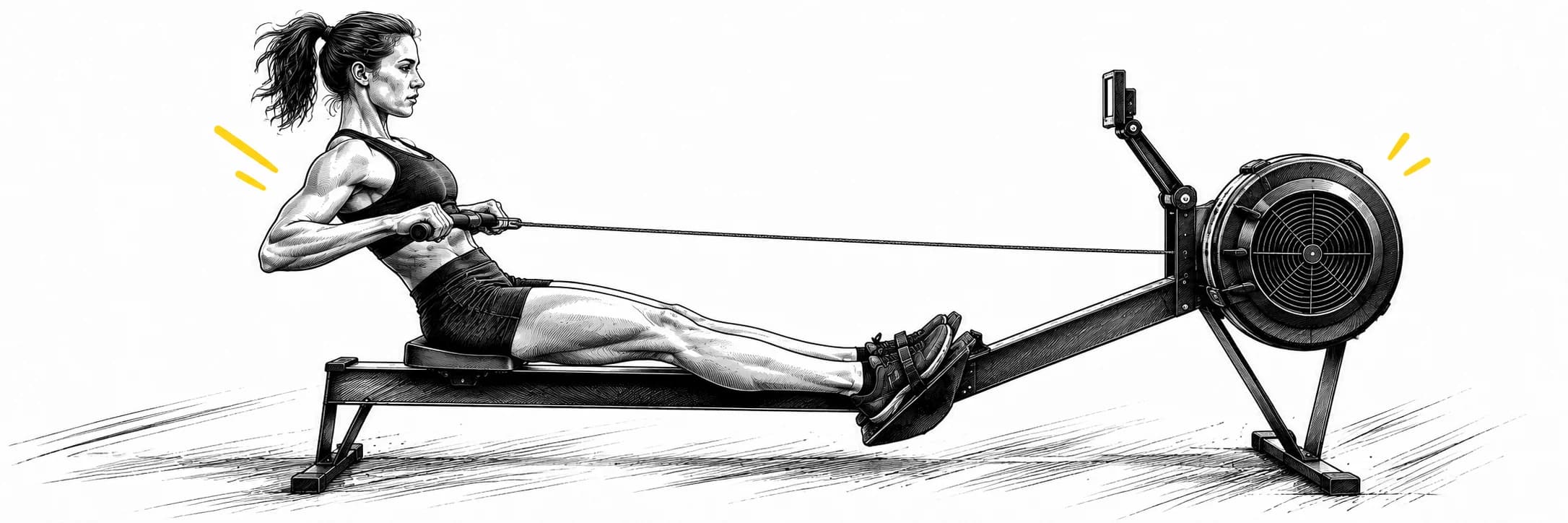
- Drive: Start with the legs, open the trunk through vertical, then finish with the arm pull.
- Finish: Legs extended, trunk leaning slightly back and handle below the ribs. Keep the wrists flat and grip relaxed.
- Recovery: Extend the arms, hinge the trunk forwards, then bend the knees after the hands have passed them.
These are Concept2’s technique cues. They do not require a fixed 60/20/20 power distribution, a precise halfway point for opening the trunk or a forced knee-locking test.
Concept2 · Rowing Technique · Concept2 · PM5
A first practice session
Concept2’s first-workout example starts with 3–5 minutes of rowing, followed by a break to walk and stretch. If it feels good, its suggestion is up to four short rowing intervals. This is an introductory option, not a minimum dose or a test you must pass on day one.
For focused technique practice, the manufacturer also demonstrates legs-only rowing and deliberate pauses between parts of the stroke. Choose one cue to observe at a time. A coach can help review the sequence rather than diagnosing your technique solely from which muscle feels tired first.
Concept2 · First Workouts · Concept2 · Rowing Drills
Progress by task, not a deadline
Use the following as an optional checklist over your first weeks, repeating a stage when useful. It is not a promise that every beginner will learn in four weeks.
- Get familiar with the foot support, handle, seat and monitor.
- Practise the stroke in short pieces with breaks.
- Try a longer continuous piece when you are comfortable with the sequence.
- Record a controlled 1,000-metre attempt when ready, then use it as your own reference.
This checklist adapts the manufacturer’s gradual introduction. It does not prescribe a universal weekly frequency, a 30-second pace jump, or a guaranteed finishing time.
Understand pace and stroke rate
Pace on the rowing monitor is time per 500 metres. A smaller number means faster rowing: holding 2:15/500 m gives 4:30 over 1,000 metres; holding 2:20 gives 4:40. Whether either pace is sustainable for you is a separate question.
Stroke rate is strokes per minute. It is not the same as speed or intensity: the PM5 guidance distinguishes how often you pull from how hard you pull. Its one-count drive and two-count recovery is a rhythm cue, not a requirement to spend exactly one and two seconds on every stroke.
What to check while practising
Compare what you see with the manufacturer’s sequence: leg drive before the arm finish, relaxed shoulders and grip, then hands away before the knees bend on the return. The catch should stay within a comfortable range. Difficulty reaching it does not, by itself, diagnose tight hip flexors or justify a claim that five extra degrees will produce a certain wattage gain. Foot-support adjustment is another factor to check.
For the race, remain seated until the judge confirms completion of the 1,000 metres, then return the handle to its holder. The monitor reaching the distance does not replace the judge’s confirmation.
Concept2 · Rowing Technique · Concept2 · Foot Position · HYROX® Singles 26/27 · §1 / §2 / §8.5
What the research does and does not show
Winkert’s study of 14 elite male rowers and Ribeiro’s pacing study in 13 male CrossFit competitors address different populations. Neither study tested a four-week HYROX® beginner rowing programme. They do not establish a 20-minute learning guarantee, fixed male and female beginner times, or that an uncontrolled exhale diagnoses an aerobic threshold.
The practical progression here is coaching guidance. Its purpose is to organise practice, not to certify race readiness by a calendar date.
Winkert et al. (2022) · Ribeiro et al. (2024) · abstract
FAQ
What damper should a beginner use?
Concept2 suggests trying 3–5 for general rowing practice. In HYROX® Singles 26/27, the race preset is 6 and adjustment is allowed. These are different kinds of guidance, not competing rules.
Concept2 · Damper Setting · HYROX® Singles 26/27 · §1 / §2 / §8.5
How long does learning take?
The cited sources do not establish one learning deadline for HYROX® beginners. Use the practice stages as options and judge progress from your own technique and completed sessions.
Concept2 · First Workouts · Winkert et al. (2022) · Ribeiro et al. (2024) · abstract
Should I watch stroke rate or pace?
They describe different things: strokes per minute and time per 500 metres. Watch both without assuming that a higher stroke rate automatically means faster rowing.
Do I need to own a RowErg?
Owning a machine is not a Singles participation requirement. Access to a RowErg lets you practise the actual machine; the sources do not establish that two or three sessions a week are sufficient for everyone.
HYROX® Singles 26/27 · §1 / §2 / §8.5 · Concept2 · First Workouts
What is a good first 1,000-metre time?
This guide does not assign an unsupported beginner benchmark. Record your own first controlled attempt. A 2:30/500 m average equals 5:00 over 1,000 metres, but that arithmetic is not a pass mark or a four-week prediction.
Concept2 · PM5 · Winkert et al. (2022) · Ribeiro et al. (2024) · abstract
Was this helpful?
Related Articles
Rowing Machine Pace Chart for Hyrox Targets
Convert a rowing split per 500 m into a 1,000 m time for HYROX. Includes worked calculations, current Singles settings and guidance for testing a personal target.
hyrox rowing tipsHyrox Rowing Race Tips
HYROX Singles rowing tips: current station rules, monitor readings, technique cues and a practical race plan without unsupported pace formulas.
rowing plan4-Week Rowing Plan for Hyrox
A four-week HYROX rowing practice outline with adjustable sessions, current Singles rules, monitor guidance and clear limits on performance claims.
Know Where You Stand
Reading is good. Training with a plan built around your weaknesses is better. Get Repz and turn what you just read into your next session.