Rowing Machine Pace Chart for Hyrox Targets
Convert a rowing split per 500 m into a 1,000 m time for HYROX. Includes worked calculations, current Singles settings and guidance for testing a personal target.
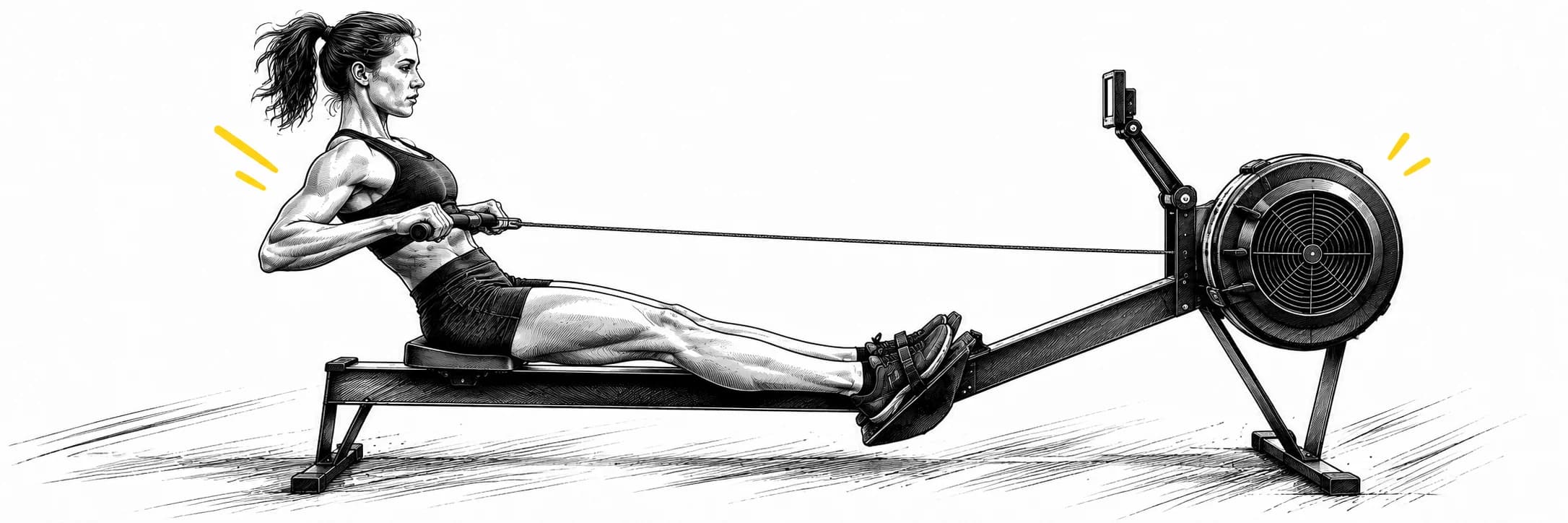
The 1,000 m row in HYROX®
Standard HYROX® Singles places the 1,000 m row at station 5, after the fifth running segment. The order around the station is Burpee Broad Jumps, run 5, rowing, run 6, Farmers Carry. Three workout stations remain after rowing. These standard Singles details should not be applied indiscriminately to every adaptive format.
HYROX® Singles 26/27 · §1 / §8.5
500 m split to 1,000 m time
Concept2 displays rowing pace in time per 500 m. The table converts an average split into total time over 1,000 m: multiply by two. It includes rowing time only, without entering or leaving the station. These examples are arithmetic references, not measured Elite, Open, male or female benchmarks. Use the average for the full distance; a single stroke’s pace is not the completed result.
| Average / 500 m | Time / 1,000 m |
|---|---|
| 1:30 | 3:00 |
| 1:45 | 3:30 |
| 2:00 | 4:00 |
| 2:15 | 4:30 |
| 2:30 | 5:00 |
| 2:45 | 5:30 |
| 3:00 | 6:00 |
Convert a 2,000 m result
Divide a 2,000 m finish time by four to calculate its average 500 m split. A 7:00 result is 420 seconds; 420 ÷ 4 = 105 seconds, or 1:45/500 m. Halving the result would give the time for 1,000 m at the same average pace, not the 500 m split. A 2,000 m result describes that effort; it does not establish a universal HYROX® target.
Percentages are not seconds
Adding 10% or 15% is different from adding ten or fifteen seconds. For a 2:00 split, 120 × 1.10 = 132 seconds (2:12), while 120 × 1.15 = 138 seconds (2:18). These calculations show how percentages work. The cited research does not validate either percentage as a fatigue correction for HYROX® rowing.
Ribeiro et al. (2024) · abstract
Damper settings
The current Singles rulebook specifies a damper preset of 6 and permits athlete adjustment. Concept2 explains that the damper controls airflow while your pulling effort determines intensity. Its general suggestion to try 3–5 is a starting point for learning, not a HYROX® requirement. Drag factor varies with the machine and conditions; a lever position is not a universal drag-factor value.
HYROX® Singles 26/27 · §1 / §8.5 · Concept2 · Damper Setting
Stroke rate and technique
Stroke rate is the number of strokes per minute. It is separate from the pace per 500 m; a higher rate alone does not guarantee a faster split. Concept2’s sequence is legs, body, arms on the drive, then arms, body, legs on recovery. Keep the grip relaxed and the wrists flat. The manufacturer guidance does not assign every HYROX® athlete an optimal 20–26 strokes per minute or a fixed 60% leg-power contribution.
Concept2 · PM5 · Concept2 · Rowing Technique
Use the table in practice
As a coaching option, choose a comfortable starting split, record the average pace and your observations of effort and technique, and compare another practice session. Including running before and after rowing lets you observe those transitions. If practising the actual station sequence, put run 5 between the Burpee Broad Jumps and rowing. This is an optional way to gather personal observations, not a proven best session or a compulsory weekly dose.
HYROX® Singles 26/27 · §1 / §8.5
What the cited study can tell us
Ribeiro and colleagues (2024) compared all-out and controlled-split pacing in 13 male regional CrossFit competitors performing Fight Gone Bad. That experiment did not measure HYROX® division rowing benchmarks, a 10–15% rowing correction or a heart-rate cutoff for Farmers Carry posture. It provides context about pacing in that workout; it cannot substantiate precise station-5 prescriptions.
Ribeiro et al. (2024) · abstract
FAQ
What average split gives a 4:30 row over 1,000 m?
2:15 per 500 m. Divide 4:30 by two. This is a time conversion, not a recommendation for every athlete.
Do I halve my 2,000 m time to find the 500 m split?
No. Divide by four. A 7:00 result gives 1:45 per 500 m. Halving gives the time for 1,000 m at that average pace.
Should everyone add 10–15% for HYROX®?
The cited study does not validate that formula. Choose a personal target through practice rather than treating a percentage as a physiological rule.
Ribeiro et al. (2024) · abstract
What damper setting is prescribed in Singles?
The current rulebook specifies a preset of 6 and allows adjustment. Concept2’s general training suggestion of 3–5 is not a compulsory race setting.
HYROX® Singles 26/27 · §1 / §8.5 · Concept2 · Damper Setting
Does a higher stroke rate guarantee a faster split?
No. Stroke rate counts strokes per minute; the 500 m split expresses pace. Use both readings as distinct information when practising.
Was this helpful?
Related Articles
Hyrox Rowing Race Tips
HYROX Singles rowing tips: current station rules, monitor readings, technique cues and a practical race plan without unsupported pace formulas.
rowing for beginnersRowing for Beginners: Hyrox
A beginner’s guide to HYROX Singles rowing: the four stroke phases, machine setup, a first practice session and reading the monitor.
rowing plan4-Week Rowing Plan for Hyrox
A four-week HYROX rowing practice outline with adjustable sessions, current Singles rules, monitor guidance and clear limits on performance claims.
Know Where You Stand
Reading is good. Training with a plan built around your weaknesses is better. Get Repz and turn what you just read into your next session.