4-Week Rowing Plan for Hyrox
A four-week HYROX rowing practice outline with adjustable sessions, current Singles rules, monitor guidance and clear limits on performance claims.
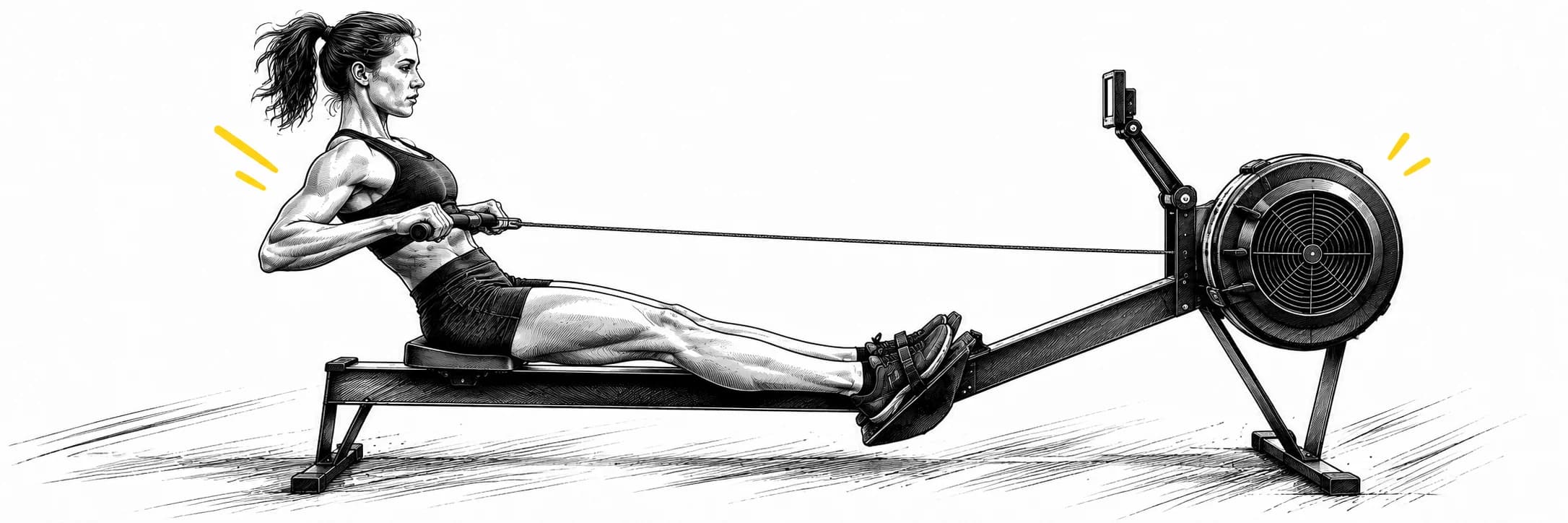
Start with the correct race sequence
In Singles 26/27, the 1,000-metre row follows run 5. SkiErg, Sled Push, Sled Pull and Burpee Broad Jumps come before it; the remaining stations are Farmers Carry, Sandbag Lunges and Wall Balls, with a run before each. Sandbags are not before rowing, and Sled Pull and BBJ are not afterwards.
HYROX® Singles 26/27 · §1 / §8.5
Set up the machine and monitor
Concept2’s damper changes airflow. Its general suggestion to try 3–5 is not a compulsory HYROX® setting: Singles 26/27 starts at 6 and allows adjustment. A lever number does not guarantee a particular drag factor on every machine.
The PM5 can programme distance intervals and rest periods, so you do not need to clear the monitor manually before every repetition. Pace and watts are mathematically related on Concept2’s calculator; switching between them is not an independent measurement of technique efficiency.
Concept2 · Damper Setting · HYROX® Singles 26/27 · §1 / §8.5 · Concept2 · PM5 · Concept2 · Pace and Watts
Practise the stroke
Concept2 describes a leg drive followed by the trunk opening and the arms finishing, with the order reversed on the return. Keep the grip relaxed and wrists flat. At the catch, use a comfortable position with straight arms and shins approaching vertical, rather than forcing extra reach.
As a coaching choice, use part of your warm-up to focus on one cue and note what changes. Stroke rate alone does not establish good or bad technique, and a fixed rate does not guarantee a fixed pace. You can revisit the rowing technique guide for more detail.
Concept2 · Rowing Technique · Concept2 · PM5
Use the four weeks as an adjustable outline
The table is an editorial training example, not a protocol tested by the studies below. It is intended for someone already comfortable with these distances. Two sessions per week is a scheduling choice here, not an optimal frequency demonstrated for all athletes. Choose days around your existing plan, and shorten, repeat or omit a session when the proposed work does not fit.
| Week | Session A | Session B | Planning focus |
|---|---|---|---|
| 1 | 3 × 500 m, 2 minutes between repetitions | 1 × 1,500 m | Practise the sequence at a manageable effort; record pace and effort |
| 2 | 4 × 500 m, 2 minutes between repetitions | 1 × 1,500 m | Repeat the intended effort; no compulsory faster split |
| 3 | 2 × 1,000 m, 4 minutes between repetitions | 4 × 500 m, 2 minutes between repetitions | Try a provisional race-effort plan without an all-out test |
| 4 | 2 × 500 m, 3 minutes between repetitions | 1 × 1,000 m | Review the plan and, if appropriate, practise the exit into running |
The main rowing sets total 3,000, 3,500, 4,000 and 2,000 metres respectively if both sessions are completed. Warm-up, cool-down and any running are additional. These totals describe this example; they do not prove an optimal progression or taper. Week 4 need not be race week.
Choose warm-up, recovery and cool-down to fit the session. This outline does not require a specific breathing-word count, a fixed stroke-rate ceiling or a guaranteed improvement between weeks. If you are entirely new to the machine, start with the beginner guidance instead of treating the table as an entry requirement.
Storoschuk et al. (2025) · abstract · Ribeiro et al. (2024) · abstract · Aagaard & Andersen (2010) · abstract
Rehearse the actual transition
At the competition row, remain seated until the judge confirms 1,000 metres and return the handle to its holder before leaving. Run 6 comes next, before Farmers Carry.
As an optional rehearsal, practise rowing followed by running. A stand-alone row is not a full race simulation, and a row followed directly by Sled Push, BBJ or sandbags is not the actual station-5 exit. Use the rehearsal to record observations, without assuming one attempt eliminates race-day stress.
HYROX® Singles 26/27 · §1 / §8.5
Assess the block alongside your other training
Keep rowing within the complete running, station and strength plan. As a practical review, compare sessions with similar setup and conditions, noting both the pace and how the effort felt. A slower final repetition is a reason to review what happened, not a validated diagnosis that you crossed your aerobic threshold.
Storoschuk’s review concerns Zone 2 evidence, Ribeiro’s study involved 13 male CrossFit competitors, and Aagaard and Andersen reviewed strength and endurance training. None validates this four-week HYROX® schedule, an 8–15-second improvement, or a universal whole-body threshold increase from rowing. The sources support bounded explanations; the schedule remains a coaching example.
Storoschuk et al. (2025) · abstract · Ribeiro et al. (2024) · abstract · Aagaard & Andersen (2010) · abstract
FAQ
How often should I row in this plan?
The example has two sessions each week. That is a planning choice, not a claim that two is optimal or that more than three causes injury. Adjust it within your complete programme.
Storoschuk et al. (2025) · abstract · Ribeiro et al. (2024) · abstract · Aagaard & Andersen (2010) · abstract
Must I use damper 4 on race day?
No. Singles 26/27 presets the damper to 6 and permits changes. A setting familiar from practice can inform your choice, but no setting is established here as best for everyone.
HYROX® Singles 26/27 · §1 / §8.5 · Concept2 · Damper Setting
What if my splits vary or I miss a week?
Review the context and decide whether to repeat, reduce or reschedule the work. The cited studies do not diagnose the cause of variation within two sessions or establish one mandatory missed-week rule.
Storoschuk et al. (2025) · abstract · Ribeiro et al. (2024) · abstract · Aagaard & Andersen (2010) · abstract
Can I use another machine?
You can choose another activity for a general workout, but this outline does not establish an equivalent HYROX® preparation dose or directly interchangeable split targets. Use the competition machine when the purpose is to practise its setup and stroke.
HYROX® Singles 26/27 · §1 / §8.5 · Storoschuk et al. (2025) · abstract · Ribeiro et al. (2024) · abstract · Aagaard & Andersen (2010) · abstract
Will the block improve every later station?
That is not demonstrated by the cited evidence. Assess rowing and the rest of the race separately rather than assuming a faster row raises every station’s physiological threshold.
Storoschuk et al. (2025) · abstract · Ribeiro et al. (2024) · abstract · Aagaard & Andersen (2010) · abstract
Was this helpful?
Related Articles
Rowing Machine Pace Chart for Hyrox Targets
Convert a rowing split per 500 m into a 1,000 m time for HYROX. Includes worked calculations, current Singles settings and guidance for testing a personal target.
hyrox rowing tipsHyrox Rowing Race Tips
HYROX Singles rowing tips: current station rules, monitor readings, technique cues and a practical race plan without unsupported pace formulas.
rowing for beginnersRowing for Beginners: Hyrox
A beginner’s guide to HYROX Singles rowing: the four stroke phases, machine setup, a first practice session and reading the monitor.
Know Where You Stand
Reading is good. Training with a plan built around your weaknesses is better. Get Repz and turn what you just read into your next session.