Hyrox Rowing Race Tips
HYROX Singles rowing tips: current station rules, monitor readings, technique cues and a practical race plan without unsupported pace formulas.
Know the actual station sequence
Before rowing, you complete five runs and four stations: SkiErg, Sled Push, Sled Pull and Burpee Broad Jumps. Each sled station covers 50 metres as four lengths of 12.5 metres. After rowing come run 6 and the 200-metre Farmers Carry, run 7 and the 100-metre Sandbag Lunges, then run 8 and 100 Wall Balls. There are three stations after rowing. These are the Singles 26/27 requirements.
HYROX® Singles 26/27 · §1 / §8.2–8.8
Check the setup before starting
The rower damper is preset to 6, and you may change it. The foot support is preset to 4 and may be adjusted before you start. Your feet must stay in the foot supports while rowing; using the straps is optional under the Singles rules.
Concept2 explains that the damper changes airflow. It does not set a fixed workout intensity or make every stroke a near-maximal leg contraction. The PM5’s drag factor reflects the drag measured by the monitor. A familiar lever number need not produce identical drag on every machine.
HYROX® Singles 26/27 · §1 / §8.2–8.8 · Concept2 · Damper Setting · Concept2 · PM5
Choose a pace from your own practice
Use your own training observations as a practical starting point rather than assuming that adding 15–20 seconds to a 2,000-metre split produces the right race pace. The critical-power review by Jones and Vanhatalo examines power-duration relationships and intermittent exercise; it does not validate that HYROX® formula. Ribeiro’s study involved 13 male CrossFit competitors, not a trial of HYROX® station-5 targets.
On the PM5, pace is time per 500 metres. Holding 2:10/500 m for 1,000 metres gives 4:20; holding 2:15 gives 4:30. These are arithmetic examples, not division averages, aerobic-zone boundaries or recommendations for every athlete.
Jones & Vanhatalo (2017) · Ribeiro et al. (2024) · abstract · Concept2 · PM5
Use checkpoints as a planning option
An optional way to organise the row is to check your plan at the start, around 500 metres and near the finish. Use the monitor to see whether your pace matches what you intended, and compare it with how the effort feels. These checkpoints are a coaching choice, not physiological phases mandated by the race.
You do not have to accelerate over the last 250 metres. At a pace exactly 5 seconds per 500 metres faster, that final 250 metres takes 2.5 seconds less. Whether that improves your overall result depends on what happens afterwards; the calculation does not guarantee a net gain. A change in stroke rate alone does not establish a particular pace change.
Keep technique cues simple
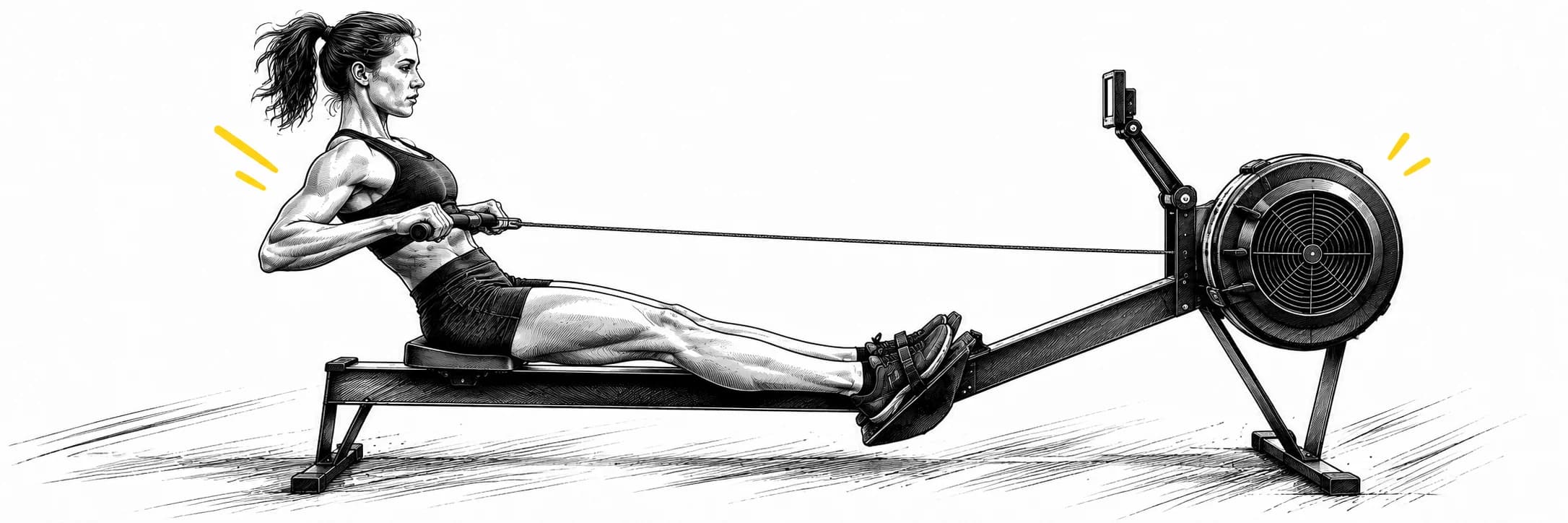
Concept2’s sequence is leg drive, trunk opening and arm finish; the return reverses that order, with the hands passing the knees before the knees bend. Keep a relaxed grip and flat wrists, and use a comfortable catch position with the shins approaching vertical.
The PM5 guidance offers a one-count drive and two-count recovery as a rhythm cue. It does not establish a half-second cardiovascular reset on every stroke. Nor do the cited sources establish that a full exhale diagnoses your aerobic threshold, or that one heart-rate percentage is a universal race-pace limit.
Concept2 · Rowing Technique · Concept2 · PM5 · Jones & Vanhatalo (2017) · Ribeiro et al. (2024) · abstract
Complete the station before leaving
Remain seated until the judge confirms the full 1,000 metres, and put the handle back in its holder before leaving. Then follow the route into run 6; you do not walk straight from the rower to the kettlebells.
The rulebook does not require a 15-second pause, five breaths or leg shakes. The sources here do not demonstrate that such a routine prevents diaphragm spasm or a “quad lock”, or that it reliably wins back more time later.
HYROX® Singles 26/27 · §1 / §8.2–8.8
Rehearse and assess the whole sequence
As a coaching option, record the rowing split and the following run when trying an effort plan in training. Compare the full sequence rather than only the rowing number. If you are practising the order immediately before station 5, remember that run 5 separates Burpee Broad Jumps and rowing. A direct BBJ-to-row workout is a different exercise combination.
The cited pacing research does not identify one weekly frequency, a six-to-eight-week programme or a negative-split pattern as optimal for HYROX® rowing. It also does not show that arriving below 165–170 bpm guarantees sets of 10–15 Wall Balls, or that exceeding 180 bpm forces sets of 3–5.
HYROX® Singles 26/27 · §1 / §8.2–8.8 · Jones & Vanhatalo (2017) · Ribeiro et al. (2024) · abstract
FAQ
What split should I target at station 5?
Use a target informed by your own practice. The cited evidence does not validate a universal 2k split plus 15–20 seconds formula. Pace calculations convert time and distance; they do not identify your physiological threshold.
Jones & Vanhatalo (2017) · Ribeiro et al. (2024) · abstract · Concept2 · PM5
Should I row harder to recover lost time?
That is a tactical decision, not something these sources resolve for every athlete. A faster row reduces rowing time, but the overall result also includes the remaining runs, stations and transitions.
HYROX® Singles 26/27 · §1 / §8.2–8.8 · Jones & Vanhatalo (2017) · Ribeiro et al. (2024) · abstract
Is a damper setting of 3–5 compulsory?
No. In Singles 26/27 the preset is 6 and you may adjust it. Concept2’s general damper guidance is separate from the race rule.
HYROX® Singles 26/27 · §1 / §8.2–8.8 · Concept2 · Damper Setting
How can I practise the station sequence?
An optional rehearsal can include the run before rowing and the run after it. In the race, BBJ is followed by run 5, then rowing, then run 6. Direct BBJ-to-row or row-to-carry combinations omit a run.
HYROX® Singles 26/27 · §1 / §8.2–8.8
How much time does a slower split cost?
If maintained for the full 1,000 metres, a split 5 seconds per 500 metres slower adds 10 seconds. That calculation alone cannot tell you how much effort is saved or which strategy gives your best total time.
Was this helpful?
Related Articles
Rowing Machine Pace Chart for Hyrox Targets
Convert a rowing split per 500 m into a 1,000 m time for HYROX. Includes worked calculations, current Singles settings and guidance for testing a personal target.
rowing for beginnersRowing for Beginners: Hyrox
A beginner’s guide to HYROX Singles rowing: the four stroke phases, machine setup, a first practice session and reading the monitor.
rowing plan4-Week Rowing Plan for Hyrox
A four-week HYROX rowing practice outline with adjustable sessions, current Singles rules, monitor guidance and clear limits on performance claims.
Know Where You Stand
Reading is good. Training with a plan built around your weaknesses is better. Get Repz and turn what you just read into your next session.