Rowing Endurance for Hyrox
Rowing endurance for HYROX: understand easy training, intensity zones and the limits of the evidence, then plan practice around the actual race sequence.
Put rowing in its race context
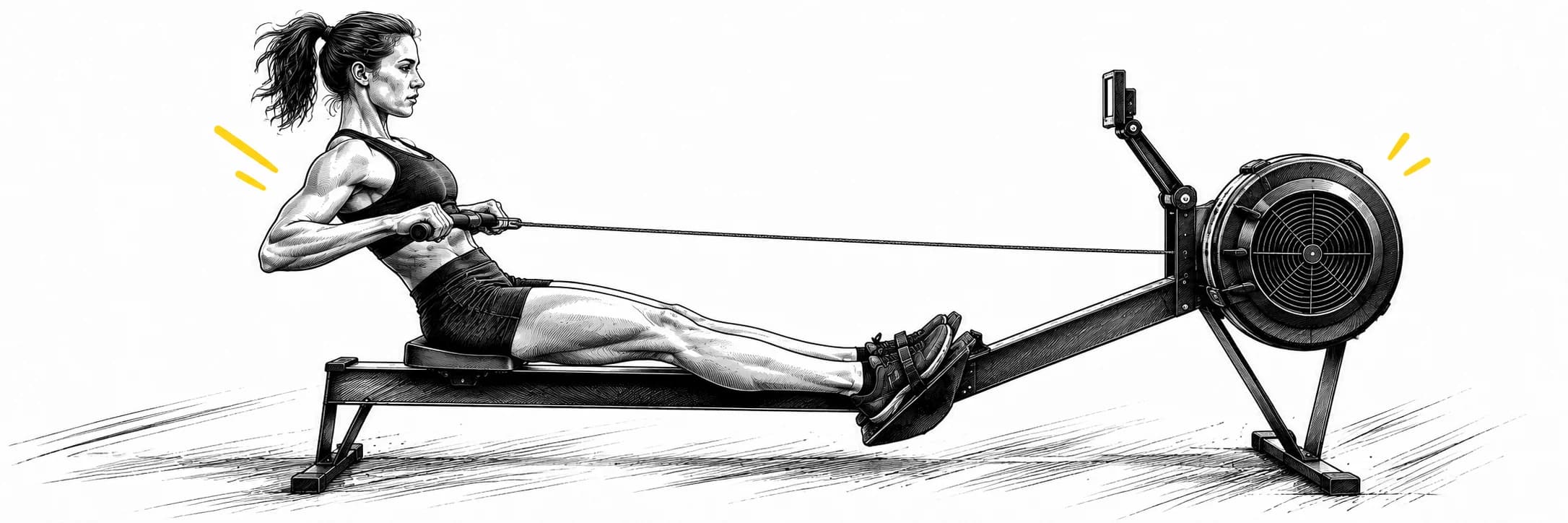
In Singles 26/27, rowing is station 5: 1,000 metres after run 5. Run 6 follows before the Farmers Carry. An optional practice log can therefore include both the row and the following run, rather than judging the session only by the fastest rowing split.
HYROX® Singles 26/27 · §1 / §8.1 / §8.5
What the endurance evidence actually supports
Storoschuk and colleagues’ 2025 review does not establish Zone 2 as uniquely effective or optimal for mitochondrial adaptations. San-Millán and Brooks compared metabolic responses across groups; their study was not a trial establishing a HYROX® training dose.
A practical planning question is which sessions you can complete consistently alongside running and station practice. Treat easy rowing and harder work as choices within that plan, rather than assuming that one specific intensity guarantees a race improvement.
Storoschuk et al. (2025) · abstract · San-Millán & Brooks (2018) · abstract
Define intensity before using a zone number
Jamnick and colleagues explain why fixed percentages of maximum heart rate do not reliably place different people in the same physiological intensity domain. Specify the zone system and how its boundaries were established before attaching “Zone 2” to a workout.
Quinn and Coons studied a passage-reading talk test in 15 people on a treadmill. That does not validate a five-to-six-word test between rowing strokes. Use conversational comfort as a rough observation, not a threshold measurement or a reason to force everyone into 60–70% of maximum heart rate.
Jamnick et al. (2020) · abstract · Quinn & Coons (2011) · abstract
Start with a manageable practice session
For people new to the machine, Concept2 offers an introductory workout of 3–5 minutes followed by a break, repeated up to four times if it feels good. That is a manufacturer’s starting option, not a minimum effective endurance dose.
For your own session, decide beforehand whether the aim is familiarisation, easy continuous practice or a harder workout. As a coaching option, record duration, pace and perceived effort, and review whether you maintained the intended effort. Do not assume that an easy row must last 40–60 minutes or that adaptation starts only after the first 10–15 minutes.
The damper controls airflow, not a fixed physiological zone. Concept2 suggests trying settings 3–5 in general training; the Singles 26/27 race preset is 6 and can be adjusted.
Concept2 · Getting Started · Concept2 · Damper Setting · HYROX® Singles 26/27 · §1 / §8.1 / §8.5 · Storoschuk et al. (2025) · abstract
Count the complete training week
Seiler’s 2010 review describes roughly 80% low-intensity sessions among high-level endurance athletes training 10–13 times weekly. It does not prescribe 70–75% of weekly minutes to every HYROX® athlete.
An optional weekly log should include running, rowing, circuits and other training rather than leaving out sessions that complicate the ratio. Label whether a percentage refers to sessions or minutes. Two rowing sessions lasting 30 and 45 minutes total 75 minutes of rowing; that alone says nothing about the intensity distribution of the entire week.
Review progress without arbitrary diagnoses
Choose repeatable observations as a coaching tool: the duration you completed, pace, perceived effort and the following run when included. Record the circumstances so that you can compare like with like.
The cited studies do not validate a 3:30/500 m cutoff, an inability to row 40 minutes below 70% of maximum heart rate, or a ten-second slowdown as a diagnosis of inadequate aerobic development. They also do not establish a universal four-to-six-week fix. Review the overall plan rather than assigning a physiological diagnosis from one split.
Jamnick et al. (2020) · abstract · Quinn & Coons (2011) · abstract · Storoschuk et al. (2025) · abstract · San-Millán & Brooks (2018) · abstract · Seiler (2010) · abstract
FAQ
How slow should easy rowing be?
There is no universally valid split or maximum-heart-rate percentage in the sources cited here. Define the intended effort and the method you use to assess it; do not assume that a slower number automatically proves the correct zone.
Jamnick et al. (2020) · abstract · Quinn & Coons (2011) · abstract
How many easy rowing sessions do I need?
These sources do not establish two as a minimum, three as optimal or more than four as excessive for every HYROX® athlete. Choose the frequency as part of your complete training plan.
Must easy rowing come before intervals on the same day?
No universal ordering rule is established by the evidence cited here. As a planning choice, identify the priority session and assess whether the combined session fits the intended workload.
Seiler (2010) · abstract · Storoschuk et al. (2025) · abstract
Will eight weeks guarantee a faster race row?
No. The cited studies do not validate a guaranteed eight-week HYROX® outcome or the same adaptation timeline for everyone. Use your own comparable training observations to review the plan.
Storoschuk et al. (2025) · abstract · San-Millán & Brooks (2018) · abstract · Seiler (2010) · abstract
Can I replace all rowing with SkiErg?
That is not an equivalence demonstrated by these sources. Both are separate 1,000-metre stations in Singles 26/27. If your goal includes rowing familiarity, retain rowing practice rather than treating a shared “Zone 2” label as proof of identical preparation.
HYROX® Singles 26/27 · §1 / §8.1 / §8.5 · Storoschuk et al. (2025) · abstract · San-Millán & Brooks (2018) · abstract
Was this helpful?
Related Articles
Rowing Machine Pace Chart for Hyrox Targets
Convert a rowing split per 500 m into a 1,000 m time for HYROX. Includes worked calculations, current Singles settings and guidance for testing a personal target.
hyrox rowing tipsHyrox Rowing Race Tips
HYROX Singles rowing tips: current station rules, monitor readings, technique cues and a practical race plan without unsupported pace formulas.
rowing for beginnersRowing for Beginners: Hyrox
A beginner’s guide to HYROX Singles rowing: the four stroke phases, machine setup, a first practice session and reading the monitor.
Know Where You Stand
Reading is good. Training with a plan built around your weaknesses is better. Get Repz and turn what you just read into your next session.