Sled Pull vs Push Differences
Compare HYROX Sled Push and Sled Pull using current Singles weights, movement rules, muscle functions and practical training options.
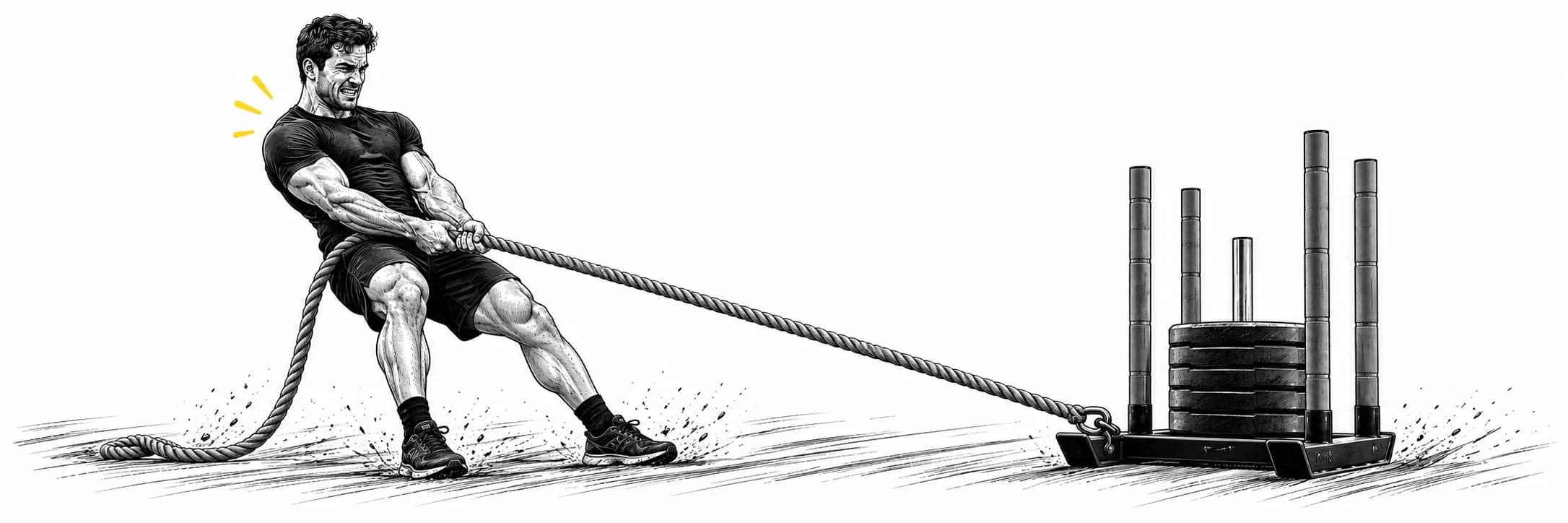
Two stations with a run between them
Sled Push is station 2, after run 2. Sled Pull is station 3, after run 3: you run between them rather than moving straight from one sled to the other. Both stations cover 50 m as four 12.5 m lengths. The difference is the task: pushing the sled by its poles versus pulling it with a rope. Practise the two tasks without assuming either that they are identical or that they share no training adaptations.
HYROX® Singles26/27 · §1/4.1/8.2/8.3
Current Singles loads, including the sled
The table shows the 26/27 Singles totals. All values include the sled; they are not the plates to add. These are not specifications for every other HYROX® format. Women Open use 24 kg less for the pull than the push; the difference is 49 kg in the other three divisions shown. Those differences follow directly from the official totals. They do not establish why HYROX® chose the weights or which movement should feel harder.
| Division | Sled Push | Sled Pull |
|---|---|---|
| Women Open | 102 kg | 78 kg |
| Men Open | 152 kg | 103 kg |
| Women Pro | 152 kg | 103 kg |
| Men Pro | 202 kg | 153 kg |
HYROX® Singles26/27 · §1/4.1/8.2/8.3
Movement rules before technique preferences
At either station, move the entire sled beyond the line before changing direction. At Sled Push, complete all four lengths in the assigned lane. At Sled Pull, pull standing: sitting and kneeling are prohibited. Stay inside the front and rear solid lines of the Racers Box while holding the rope; keep the rope in your lane without obstructing others. Backward steps must fit within that box. A compulsory 45-degree torso angle, locked elbows, 80–100 steps per minute or a pull ending at the hip is not specified by these rules. Treat individual technique cues as coaching choices.
HYROX® Singles26/27 · §1/4.1/8.2/8.3
Muscles: overlapping roles, different tasks
Anatomy helps describe actions: quadriceps extend the knee; gluteus maximus extends the hip; the calf muscles contribute to plantar flexion. In the upper body, latissimus dorsi moves the arm, elbow flexors bend the elbow, and finger flexors close the fingers. These roles do not divide the two stations into isolated front and back halves of the body. They also do not quantify force shares or establish that the grip always fails first. A small sled-push EMG experiment compared ten men pushing a sled with back squats; it did not compare the two HYROX® stations or determine a universal muscle hierarchy.
OpenStax · lower-limb muscles · OpenStax · upper-limb muscles · Maddigan et al.2014 · sled push versus squat EMG
Pacing without invented benchmarks
As a coaching option, practise an effort that lets you complete the lane within the rules and continue with the next run. Record the complete sequence if you are testing your own pacing. The sources cited here do not establish 60–90 seconds as the target for most Open athletes, a universal 90–95% effort ceiling, or an 18-second average penalty at Sled Pull. They do not demonstrate that every athlete should use negative splits or that the first 10 m forms a fixed physiological phase. Judge changes against your own comparable sessions rather than an invented population benchmark.
Cahill et al.2019 · resisted sprinting · Hindle et al.2019 · strongman biomechanics
Why stroke count is not a diagnosis
Stroke count alone cannot identify weak grip, poor posture or an ideal technique. It depends on what you count and how far the sled actually moves. In a simplified arithmetic example, moving a total of 50 m in 0.5 m increments requires 100 increments. If the actual advance were 0.9 m or 0.6 m per increment, the unrounded counts would be approximately 55.6 and 83.3. This is division, not a technique target or a prediction of fatigue. Rope taken in and sled travel must not be silently treated as the same measurement when you change body position.
HYROX® Singles26/27 · §1/4.1/8.2/8.3
A flexible way to practise both
One planning option is to practise each station separately with manageable loads, then add a push–run–pull sequence when appropriate to your preparation. Choose the running distance, recovery and total work deliberately. A shortened training run is not the full race segment. Count this work within your existing programme rather than making a weekly full-load simulation mandatory. The cited research does not validate a universal eight-week block, fixed 60–70% and 70–80% phases, or a five-day cutoff for everybody. For equipment and rule details, see the Sled Pull equipment guide.
HYROX® Singles26/27 · §1/4.1/8.2/8.3 · Cahill et al.2019 · resisted sprinting · Hindle et al.2019 · strongman biomechanics · NSCA Coach · individual sled loading
What the cited research actually covers
Cahill and colleagues’ 2019 article addresses resisted sprinting; its sled-pulling discussion includes harness attachment at the waist or shoulders. That is not the same task as standing hand-over-hand HYROX® rope pulling. Hindle and colleagues reviewed eleven strongman biomechanics articles, including heavy sled towing and other events. The review does not establish a HYROX® station-time ranking or validate the training block above. Its 2020 correction concerns table symbols. Use these sources for their stated scope, without presenting extrapolations as measured race outcomes.
Cahill et al.2019 · resisted sprinting · Cahill2019 · thesis · Sled Pushing and Pulling · Hindle et al.2019 · strongman biomechanics · Hindle et al.2020 · table-symbol correction
FAQ
Is Sled Pull always harder than Sled Push?
No universal ranking is established by the sources here. The task and official load differ. Compare your own execution and subsequent running rather than assuming one station must be your weakness.
HYROX® Singles26/27 · §1/4.1/8.2/8.3 · Hindle et al.2019 · strongman biomechanics
How much lighter is Sled Pull?
For 26/27 Singles totals including the sled, Women Open drop from 102 to 78 kg: 24 kg. Men Open and Women Pro drop from 152 to 103 kg, and Men Pro from 202 to 153 kg: 49 kg in each case.
HYROX® Singles26/27 · §1/4.1/8.2/8.3
Can I prepare without a sled?
Other exercises can be training options, but the cited studies do not establish full equivalence with either station. Use suitable equipment and practise the actual movement rules when you have access to a sled.
Cahill et al.2019 · resisted sprinting · Hindle et al.2019 · strongman biomechanics
What happens between the two sled stations?
Run 3 separates Sled Push from Sled Pull. Follow the event’s designated running route. A mandatory 200/600/200 m pacing formula or guaranteed recovery is not established here.
HYROX® Singles26/27 · §1/4.1/8.2/8.3
Should I train the two stations together?
You can use separate practice and an appropriately scaled combined session as planning options. Neither a weekly race-load simulation nor a fixed eight-week progression is a universal requirement.
Cahill et al.2019 · resisted sprinting · Hindle et al.2019 · strongman biomechanics · NSCA Coach · individual sled loading
Was this helpful?
Related Articles
Grip Training for Sled Pull
Prepare your grip for the HYROX Sled Pull: current rope specifications, training options, chalk and glove rules, and practical skin care.
sled pull exerciseSled Pull for Beginners
Beginner’s guide to the HYROX Sled Pull: current Singles weights, four 12.5 m lengths, a practical learning progression and equipment alternatives.
sled pull workoutSled Pull Workouts for Hyrox
Sled Pull workouts for HYROX Singles: current station rules and loads, optional practice sessions, and guidance for choosing manageable training demands.
Know Where You Stand
Reading is good. Training with a plan built around your weaknesses is better. Get Repz and turn what you just read into your next session.