Rowing Stroke
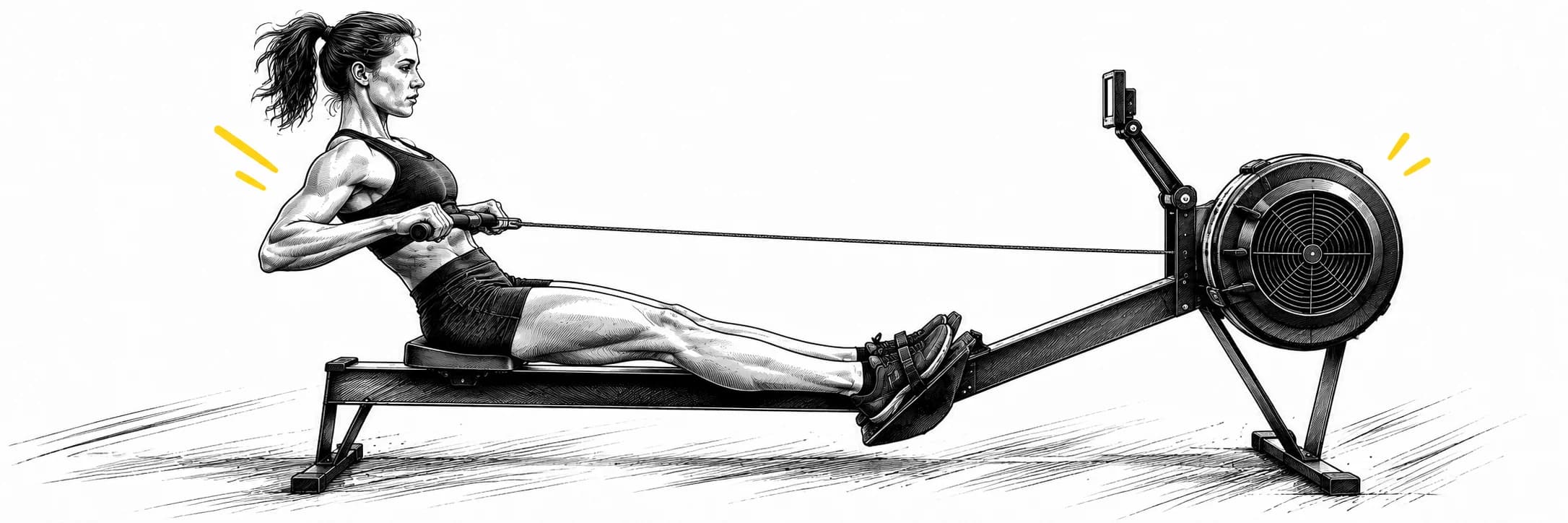
A rowing stroke is one complete cycle on a rowing ergometer: catch, drive, finish and recovery.
A rowing stroke is one complete cycle on a rowing ergometer: catch, drive, finish and recovery.
The four phases
At the catch, use straight arms, relaxed shoulders in front of the hips and shins near vertical. Start the drive with the legs, then move the body through vertical and add the arm pull. At the finish, the legs are extended, the torso leans back slightly and the handle sits below the ribs. For recovery, extend the arms, hinge forward and bend the knees after the hands pass them.
The HYROX® context
In standard Singles, the HYROX® row is station 5: 1,000 m after running segment 5. Another run separates it from Farmers Carry. The race preset is damper 6, adjustable by the athlete. This preset is distinct from drag factor, which varies with the machine and conditions.
HYROX® Singles 26/27 · §1 / §8.5 · Concept2 Damper / Drag Factor
Practice and monitor readings
Stroke rate is strokes per minute; pace on the RowErg is time per 500 m. Read both values instead of equating a higher rate with faster rowing. For practice, Concept2 offers legs-only drills, pauses and rhythm counting. Its one-beat drive/two-beat recovery cue is an exercise aid rather than a compulsory HYROX® standard. Choose manageable practice with your coach.
Concept2 PM5 · Units / Stroke Rate · Concept2 Rowing Drills
FAQ
How do I calculate a 1,000 m rowing time?
Double the average pace per 500 m: 2:00/500 m gives 4:00 for 1,000 m, excluding setup and transitions. This is arithmetic, not a competitive or beginner benchmark.
Concept2 PM5 · Units / Stroke Rate
Is there one ideal HYROX® stroke rate?
No universal ideal is established here. Stroke rate and pace are different readings. Compare comfortable rates in training and monitor the resulting pace rather than applying fixed upper or lower cutoffs.
Concept2 PM5 · Units / Stroke Rate
Losing time on the rower? See where you're losing time and what to train first.
Was this helpful?