HYROX men's wall ball weight: Open and Pro
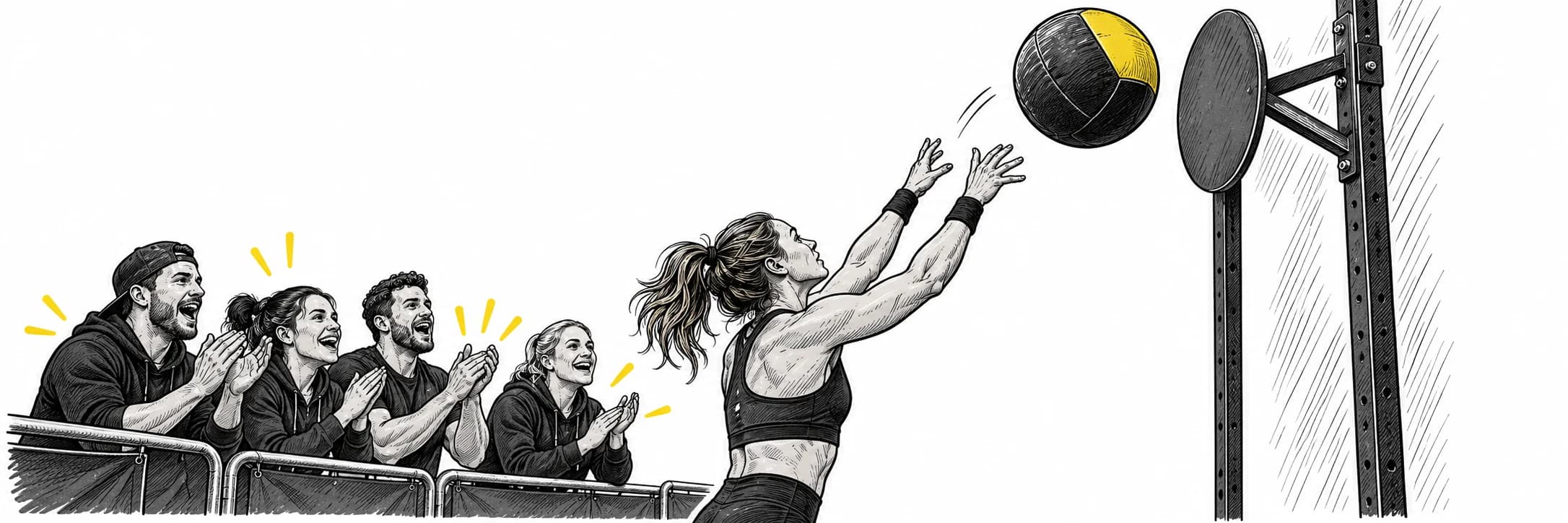
Match the weight to your entry
For a standard Men's Open Singles entry, choose the 6 kg ball. For Men's Pro Singles, choose 9 kg. Check the weight marking rather than judging by diameter or by the ball you usually use in training.
The same men's load distinction appears in standard Doubles: Men use 6 kg and Men Pro use 9 kg, sharing 100 repetitions as a team. Mixed Doubles uses 6 kg for both partners; the male partner targets 3.00 m and the female partner 2.70 m. Do not infer Relay or Adaptive requirements from this Singles and Doubles summary.
Weight alone does not validate a repetition
Begin standing tall, squat with hips below knees and throw with both hands onto the correct physical target. After letting the ball reach the floor, reset standing before starting another squat. Catching a bounce and immediately continuing is not allowed.
Wall balls follow the eighth run, not the fourth. Finish the required valid repetitions and obtain confirmation of completion before leaving. Full movement rules matter as much as selecting the correct load.
Practise the change to Pro
Treat 9 kg as a separate practice condition, not as a guaranteed percentage increase in station time. Begin with manageable sets and compare depth, target contact and control with your 6 kg work. Adjust volume to your existing training.
Five sets of 20 would total 100, but this is an example rather than an optimal men's pacing formula. Breaks can be longer or sets smaller if needed. You do not have to prove readiness by attempting 100 unbroken in every session.
For the other divisions, see HYROX® wall ball weight.
Questions
What is the men's Open ball weight?
6 kg for 100 valid repetitions to a 3.00 m target in standard Singles.
What changes in Men's Pro?
The ball increases to 9 kg. The standard remains 100 repetitions to 3.00 m.
Do Men's Doubles athletes each perform 100?
No. The team shares 100 repetitions. Men use 6 kg and Men Pro 9 kg.
Sources
Singles rulebook 2026/27, sections 1 and 8.8; Doubles rulebook 2026/27, sections 7.1 and 8.8.
Was this helpful?